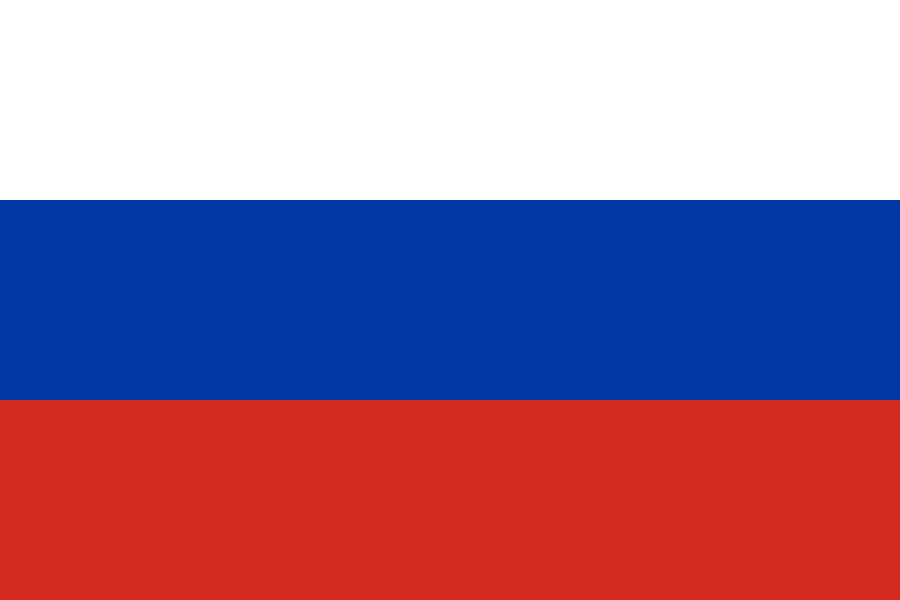
Adopted in 1991
| Capital | Moscow |
|---|---|
| Population | 143 533 851 inh. |
| Area | 17 098 200 km² |
| Population density | 8.4 inh./km² |
| Local time | --:-- (multiple time zones) |
| Language(s) | Russian |
| Political system | Federal semi-presidential constitutional republic |
| National anthem | Gosudarstvenny gimn Rossiyskoy Federatsii (State Anthem of the Russian Federation) |
| Currency | Russian ruble (RUB) |
| History | View timeline |
| Land borders | Norway, Finland, Estonia, Latvia, Belarus, Lithuania, Poland, Ukraine, Georgia, Azerbaijan, Kazakhstan, China, Mongolia, North Korea |
| Maritime borders | Arctic Ocean, Pacific Ocean, Caspian Sea, Black Sea, Baltic Sea, Barents Sea, Sea of Azov |
The flag: history and symbolism
Flag History
According to tradition, white, blue and red were first hoisted in 1668 on the Oryol (‘Eagle’), the first warship built in Russia, during the reign of Alexis I. Peter the Great then made the tricolour the ensign of the merchant navy, by a decree of 20 January 1705.
In the 19th century, a black, yellow and white flag, in the colours of the imperial arms, was adopted in 1858. In 1883, Alexander III restored white, blue and red for official celebrations, and the tricolour was recognised as the national flag in 1896, ahead of the coronation of Nicholas II.
Abandoned by the Bolsheviks after the October Revolution of 1917 in favour of the red flag, and later replaced by the flag of the Soviet Union, bearing the hammer and sickle, the tricolour returned on 22 August 1991, the day after the failure of the coup against Mikhail Gorbachev. Its status was confirmed by the federal constitutional law of 25 December 2000.
Meaning of Colours & Emblems
No official meaning is attached to the colours of the Russian flag. Several interpretations have circulated since the 19th century:
- White: nobility and candour, or faith.
- Blue: loyalty and honesty, or hope. It is also associated with the Virgin Mary, protector of Russia.
- Red: courage and generosity, or charity.
Another, older reading sees in it the union of White Russia, Little Russia and Great Russia, that is, of the Belarusian, Ukrainian and Russian peoples.
Anecdotes & Fun Facts
In the 19th century, white, blue and red became the pan-Slavic colours, adopted by the Slavic Congress in Prague in 1848. They can be found today on the flags of Serbia, Slovakia, Slovenia, Croatia and the Czech Republic.
22 August, the anniversary of the restoration of the tricolour in 1991, has been celebrated every year since 1994 as National Flag Day.
The Russian flag resembles that of the Netherlands, whose colours are arranged in a different order. According to one tradition, Peter the Great drew inspiration from the Dutch flag after studying shipbuilding in Amsterdam, but the existence of the Russian tricolour as early as 1668 casts doubt on this theory.
Similar Flags Around the World


Sport and history
Athletes
- Yelena Isinbayeva
- Andreï Tchmil
- Denis Menchov
- Evgueni Berzin
- Pavel Tonkov
- Sergueï Ivanov
- Vladimir Karpets
- Lidiya Grigoryeva
- Svetlana Zakharova
- Abdulrashid Sadulaev
- Aleksei Tishchenko
- Aliya Mustafina
- Andrey Moiseev
- Buvaisar Saitiev
- Mavlet Batirov
- Roman Vlasov
- Vitalina Batsarashkina
- Yevgeniya Kanayeva
- Evgeny Rylov
Olympic Games
History
Historical figures
Frequently asked questions
What is the capital of Russia?
Moscow is the capital of Russia.
What do the colours of the flag of Russia mean?
No official meaning is attached to the colours of the Russian flag. Several interpretations have circulated since the 19th century: White: nobility and candour, or faith. Blue: loyalty and honesty, or hope. It is also associated with the Virgin Mary, protector of Russia. Red: courage and generosity, or charity. Another, older reading sees in it the union of White Russia, Little Russia and Great Russia, that is, of the Belarusian, Ukrainian and Russian peoples.
Which countries border Russia?
Russia shares land borders with: Norway, Finland, Estonia, Latvia, Belarus, Lithuania, Poland, Ukraine, Georgia, Azerbaijan, Kazakhstan, China, Mongolia, North Korea.