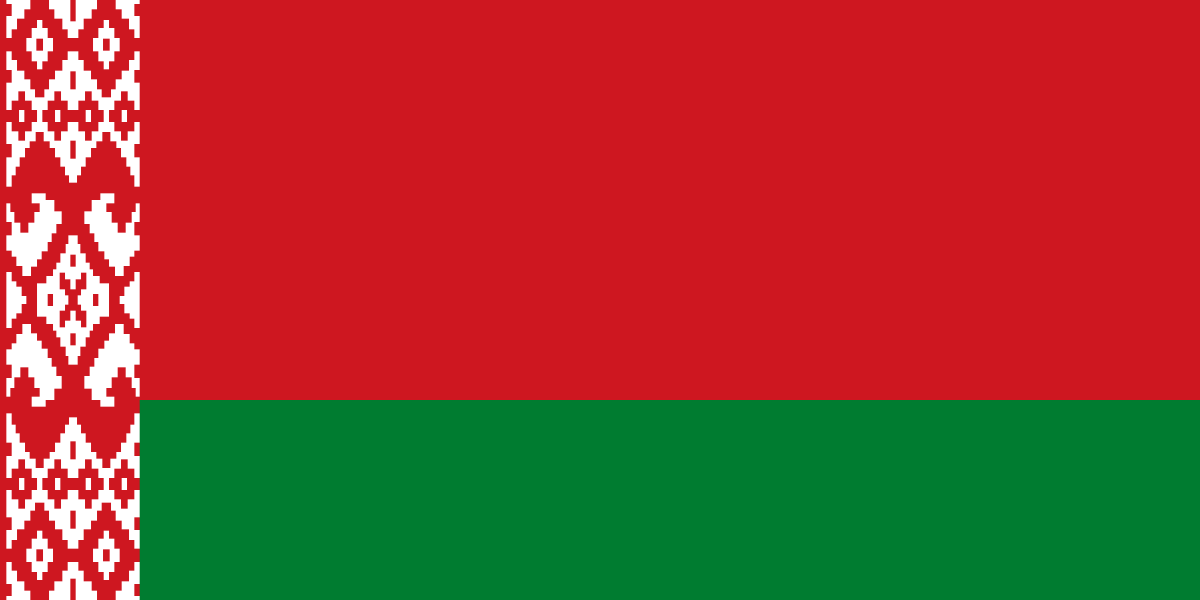
Adopted in 1995
| Capital | Minsk |
|---|---|
| Population | 9 133 712 inh. |
| Area | 207 630 km² |
| Population density | 44.0 inh./km² |
| Local time | --:-- |
| Language(s) | Russian, Belarusian |
| Political system | Unitary presidential constitutional republic |
| Currency | Belarusian ruble (BYN) |
| Land borders | Poland, Latvia, Lithuania, Russia, Ukraine |
The flag: history and symbolism
Flag History
In 1918, the short-lived Belarusian People's Republic adopted a white, red and white flag. During the Soviet period, the Byelorussian Soviet Socialist Republic used a red and green flag with a traditional ornament at the hoist and the hammer and sickle.
After independence in 1991, the white, red and white flag became the national flag again. Following a referendum held on 14 May 1995 at the initiative of President Alexander Lukashenko, it was replaced by a red and green flag close to the Soviet-era one, without the hammer and sickle.
The white, red and white flag has since become the symbol of the opposition, highly visible during the 2020 protests.
Meaning of Colours & Emblems
The elements of the official Belarusian flag are generally interpreted as follows:
- Red: victory and the blood shed, particularly during the Second World War.
- Green: the forests, the fields, and hope.
- Red and white ornament: it takes up a traditional embroidery pattern, that of embroidered towels (ruchnik), a symbol of Belarusian folk culture.
Anecdotes & Fun Facts
The ornament on the flag is based on a pattern embroidered in 1917 by a Belarusian peasant woman, Matrona Markevich.
Belarus is one of the few countries whose official flag and opposition flag are both widely known, each reflecting a different reading of the country's history.
The flag was slightly revised in 2012, with a redrawn ornament and more precisely defined shades.
Flags of Neighbouring Countries


Sport and history
Athletes
Olympic Games
Frequently asked questions
What is the capital of Belarus?
Minsk is the capital of Belarus.
What do the colours of the flag of Belarus mean?
The elements of the official Belarusian flag are generally interpreted as follows: Red: victory and the blood shed, particularly during the Second World War. Green: the forests, the fields, and hope. Red and white ornament: it takes up a traditional embroidery pattern, that of embroidered towels (ruchnik), a symbol of Belarusian folk culture.