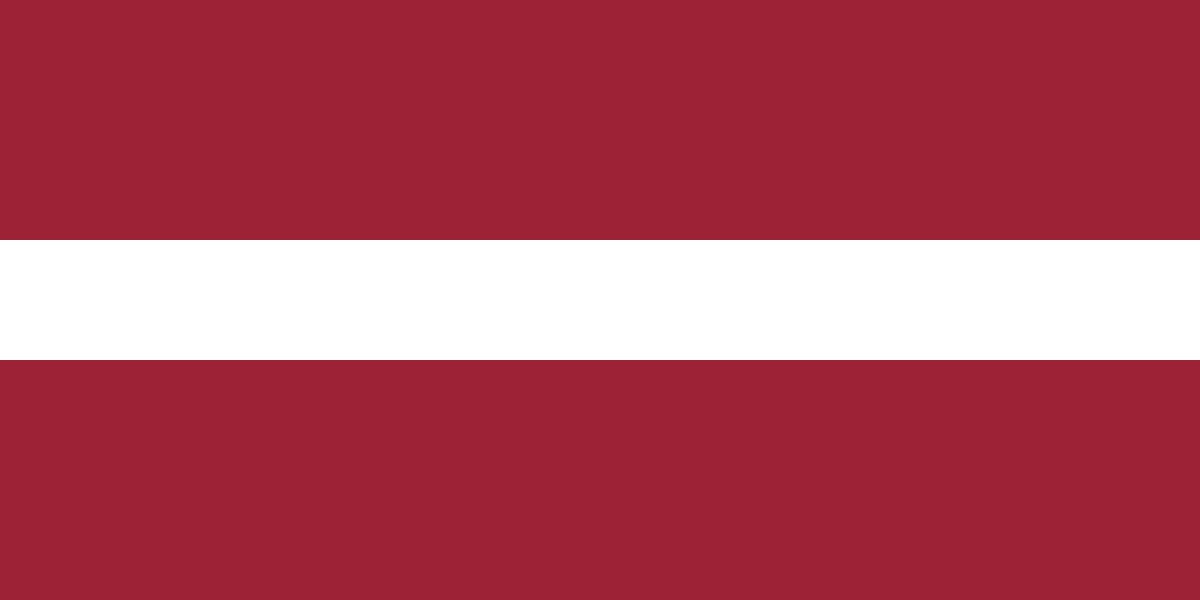
Adopted in 1922
| Capital | Riga |
|---|---|
| Population | 1 862 441 inh. |
| Area | 64 590 km² |
| Population density | 28.8 inh./km² |
| Local time | --:-- |
| Language(s) | Latviana |
| Political system | Unitary parliamentary constitutional republic |
| National anthem | Dievs, Sveti Latviju (God Bless Latvia) |
| Currency | Euro (EUR) |
| Land borders | Lithuania, Estonia, Russia, Belarus |
| Maritime borders | Baltic Sea |
The flag: history and symbolism
Flag History
According to the Livonian Rhymed Chronicle, written at the end of the 13th century, the Latvian tribes of the Cēsis area carried a red banner crossed by a white stripe as early as 1279. The modern flag takes up this design.
It was designed in 1917 by the artist Ansis Cīrulis, shortly before Latvia declared independence on 18 November 1918, and officially adopted by Parliament (the Saeima) on 15 June 1922.
Banned during the Soviet occupation, it was restored on 27 February 1990, a few weeks before Latvia declared the restoration of its independence on 4 May 1990.
Meaning of Colours & Emblems
The Latvian flag has no official interpretation, but a traditional reading draws on the legend of its origin:
- Carmine red: the blood shed in defence of the homeland. This dark shade, often called ‘Latvian red’, is specific to the flag.
- White stripe: truth, honour and faith; in the legend, the white sheet in which a wounded chieftain was wrapped.
Anecdotes & Fun Facts
According to legend, a Latvian chieftain wounded in battle was wrapped in a white sheet; only the part on which he lay remained white, while the edges were reddened by his blood.
The white stripe is half as wide as each of the red stripes, in the proportions 2, 1 and 2.
The Latvian flag is often confused with that of Austria, whose red is brighter and whose three stripes are of equal width.
Similar Flags Around the World


Sport and history
Frequently asked questions
What is the capital of Latvia?
Riga is the capital of Latvia.
What do the colours of the flag of Latvia mean?
The Latvian flag has no official interpretation, but a traditional reading draws on the legend of its origin: Carmine red: the blood shed in defence of the homeland. This dark shade, often called ‘Latvian red’, is specific to the flag. White stripe: truth, honour and faith; in the legend, the white sheet in which a wounded chieftain was wrapped.