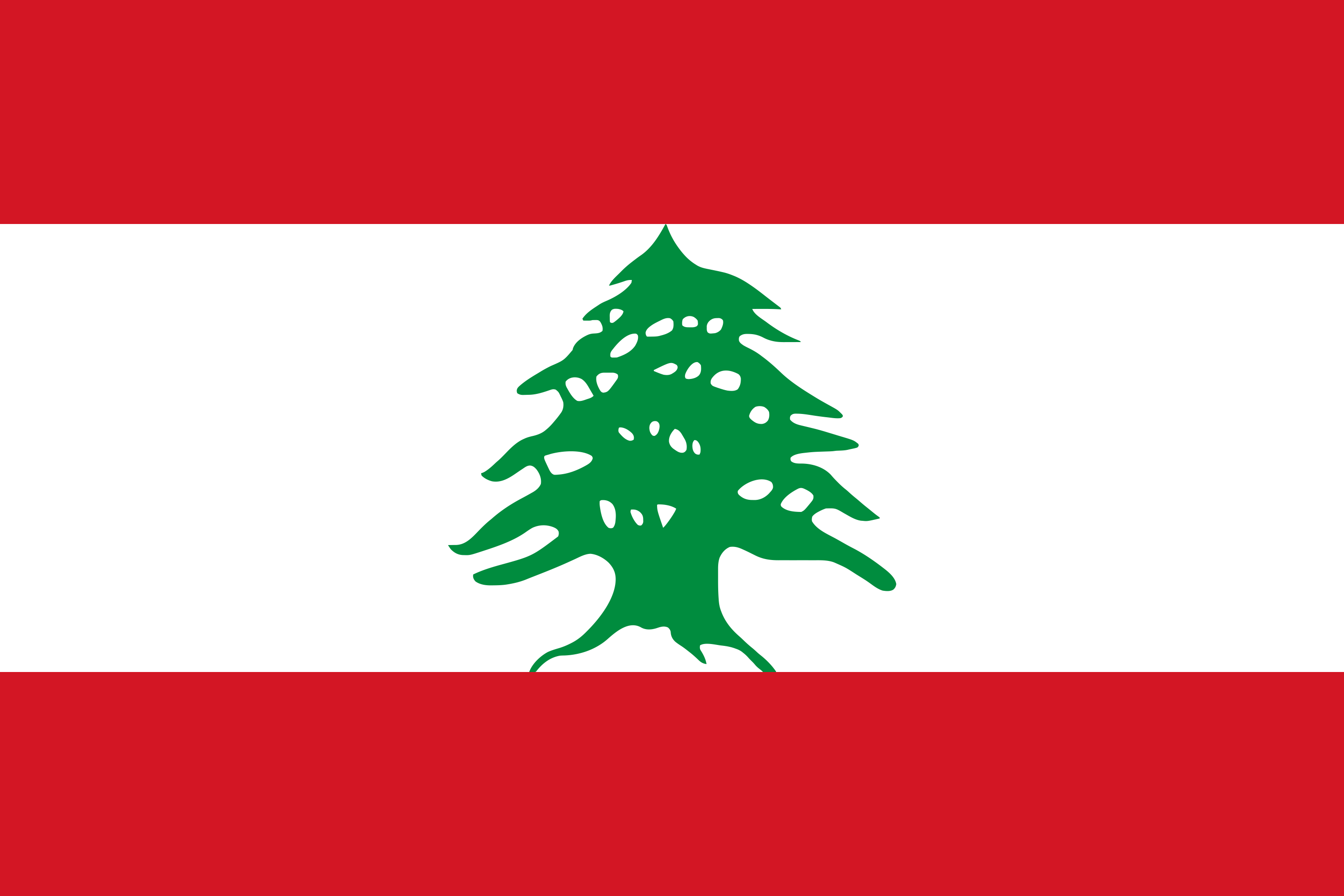
Adopted in 1943
| Capital | Beirut |
|---|---|
| Population | 5 805 962 inh. |
| Area | 10 450 km² |
| Population density | 555.6 inh./km² |
| Local time | --:-- |
| Language(s) | Arabic |
| Political system | Unitary parliamentary republic |
| National anthem | All Of Us, For the Country! |
| Currency | Lebanese pound (LBP) |
| Land borders | Syria, Israel |
| Maritime borders | Mediterranean Sea |
The flag: history and symbolism
Flag History
Under the French Mandate, Lebanon used a French tricolour bearing a cedar in the centre. In November 1943, during the crisis that led to independence, members of parliament drew and signed a new flag, whose design is attributed to Henri Pharaon.
On 7 December 1943, an amendment to Article 5 of the Constitution established the current flag: red stripes at the top and bottom and a white stripe twice as wide in the centre, with a green cedar.
Lebanon's independence is celebrated on 22 November, the day in 1943 when the Lebanese leaders imprisoned by the French authorities were released.
Meaning of Colours & Emblems
The elements of the Lebanese flag are generally interpreted as follows:
- Cedar: a symbol of Lebanon since antiquity, mentioned several times in the Bible, it represents holiness, eternity and tolerance.
- Red: the blood shed for the liberation of the country.
- White: peace, and the snow that covers Lebanon's mountains.
Anecdotes & Fun Facts
The cedars of Lebanon, including the Forest of the Cedars of God, a UNESCO World Heritage Site, were already sought after in antiquity by the Phoenicians and the Egyptians for building ships and temples.
A copy of the flag drawn and signed by the members of parliament in November 1943 has been preserved, a first-hand record of the birth of independent Lebanon.
The Lebanese flag resembles those of Austria and Latvia, but it is the only one of the three to bear an emblem in the centre, and its white stripe is twice as wide.
Similar Flags Around the World


Sport and history
National teams
Olympic Games
Frequently asked questions
What is the capital of Lebanon?
Beirut is the capital of Lebanon.
What do the colours of the flag of Lebanon mean?
The elements of the Lebanese flag are generally interpreted as follows: Cedar: a symbol of Lebanon since antiquity, mentioned several times in the Bible, it represents holiness, eternity and tolerance. Red: the blood shed for the liberation of the country. White: peace, and the snow that covers Lebanon's mountains.