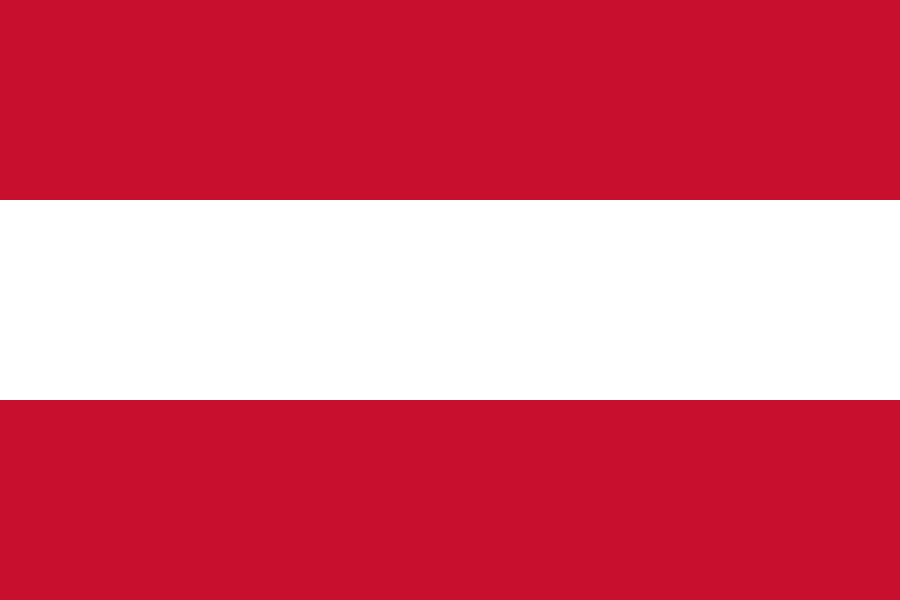
Adopted in 1945
| Capital | Vienna |
|---|---|
| Population | 9 178 482 inh. |
| Area | 83 879 km² |
| Population density | 109.4 inh./km² |
| Local time | --:-- |
| Language(s) | German |
| Political system | Federal parliamentary republic |
| National anthem | Land der Berge, Land am Strome (Land of Mountains, Land by the River) |
| Currency | Euro (EUR) |
| History | View timeline |
| Land borders | Germany, Czech Republic, Slovakia, Hungary, Slovenia, Italy, Switzerland, Liechtenstein |
The flag: history and symbolism
Flag History
Red and white are the colours of the Babenbergs, the dynasty that ruled Austria in the Middle Ages. A red shield with a white horizontal band appears on a seal of Duke Frederick II the Quarrelsome in 1230, which makes red-white-red one of the oldest national emblems in Europe.
In 1786, Emperor Joseph II made red-white-red the ensign of the Austrian navy. After the fall of the Habsburg monarchy, the Provisional National Assembly adopted it in 1918 as the flag of the Republic of Austria.
Abolished after Austria's annexation by Nazi Germany in 1938, the flag was restored in 1945, when the Republic was re-established.
Meaning of Colours & Emblems
The Austrian flag is heraldic in origin: it reproduces the Babenberg shield, later taken up by the Habsburgs in their arms.
- Red: the field of the shield, which legend associates with blood.
- White: the horizontal band across it.
Since 1945, the arms of the Republic, a black eagle, have shown broken chains, a symbol of the country's liberation.
Anecdotes & Fun Facts
According to legend, Duke Leopold V of Babenberg, at the Siege of Acre in 1191 during the Third Crusade, found his white tunic entirely soaked in blood, except for the band protected by his belt: red-white-red was supposedly born that day.
The Austrian flag is often confused with that of Latvia, whose red is darker (carmine) and whose white stripe is narrower, or with that of Lebanon, which bears a green cedar in the centre.
There are two official versions of the flag: the civil flag, simply red, white and red, and the state flag, reserved for federal authorities, which bears the arms of the Republic in its centre.
Similar Flags Around the World


Sport and history
Athletes
Olympic Games
History
Historical figures
Frequently asked questions
What is the capital of Austria?
Vienna is the capital of Austria.
What do the colours of the flag of Austria mean?
The Austrian flag is heraldic in origin: it reproduces the Babenberg shield, later taken up by the Habsburgs in their arms. Red: the field of the shield, which legend associates with blood. White: the horizontal band across it. Since 1945, the arms of the Republic, a black eagle, have shown broken chains, a symbol of the country's liberation.
Which countries border Austria?
Austria shares land borders with: Germany, Czech Republic, Slovakia, Hungary, Slovenia, Italy, Switzerland, Liechtenstein.