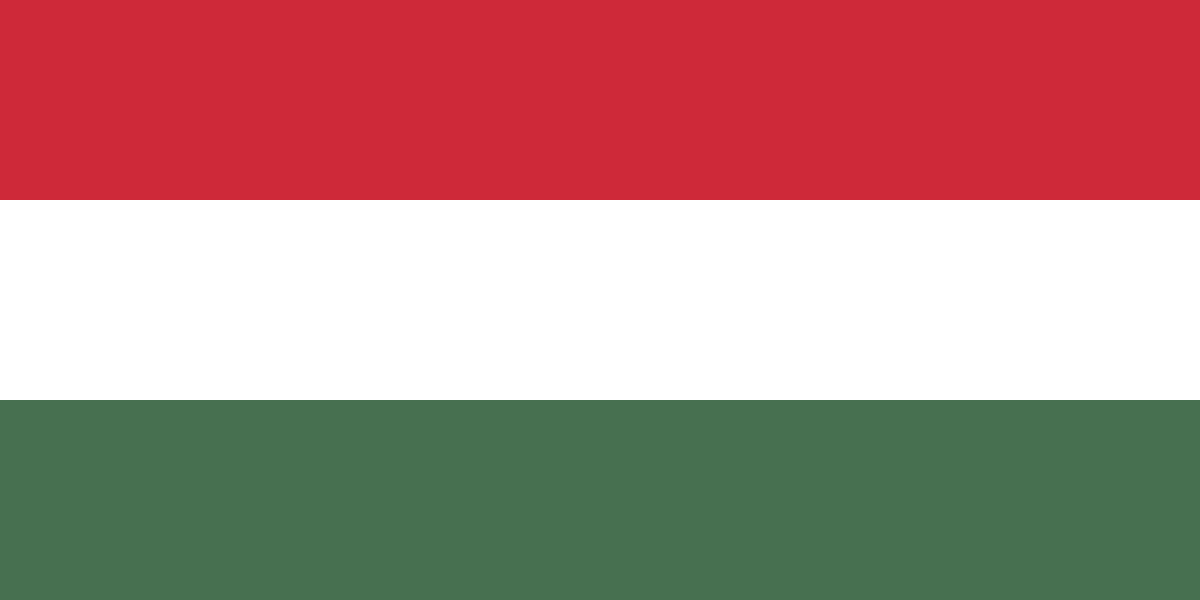
Adopted in 1957
| Capital | Budapest |
|---|---|
| Population | 9 562 314 inh. |
| Area | 93 030 km² |
| Population density | 102.8 inh./km² |
| Local time | --:-- |
| Language(s) | Hungarian |
| Political system | Unitary parliamentary constitutional republic |
| National anthem | Himnusz |
| Currency | Hungarian forint (HUF) |
| Land borders | Austria, Serbia, Croatia, Slovenia, Romania, Ukraine, Slovakia |
The flag: history and symbolism
Flag History
Red, white and green come from the Hungarian coat of arms: the red and white stripes of the Árpád dynasty and the green triple mount topped by a cross. These colours were used together as early as the 17th century, notably on seals and royal cords.
The tricolour became established during the revolution of 1848, and the April Laws of 1848 recognised it as the national flag. During the communist period, it bore the arms of the People's Republic in its centre.
After the uprising of 1956, the communist emblem disappeared from the flag, which became a plain tricolour again in 1957. The Fundamental Law of 2011 confirms its description.
Meaning of Colours & Emblems
The most widespread interpretation, which has no official status, is as follows:
- Red: strength and the blood shed for the homeland.
- White: faithfulness.
- Green: hope.
The three colours are above all heraldic: they reproduce the colours of the national coat of arms, which appears on the state flag.
Anecdotes & Fun Facts
During the uprising of October 1956 against the Soviet-backed regime, the insurgents cut the communist emblem out of the centre of their flags. The ‘flag with a hole’ became the symbol of the 1956 revolution.
The Hungarian flag resembles the Italian flag, with the same colours arranged vertically, and that of Iran, which places them in reverse order with a central emblem.
15 March, a national holiday, commemorates the start of the 1848 revolution: on that day, many Hungarians wear a cockade in the colours of the flag.
Similar Flags Around the World


Sport and history
National teams
Clubs
Olympic Games
Frequently asked questions
What is the capital of Hungary?
Budapest is the capital of Hungary.
What do the colours of the flag of Hungary mean?
The most widespread interpretation, which has no official status, is as follows: Red: strength and the blood shed for the homeland. White: faithfulness. Green: hope. The three colours are above all heraldic: they reproduce the colours of the national coat of arms, which appears on the state flag.