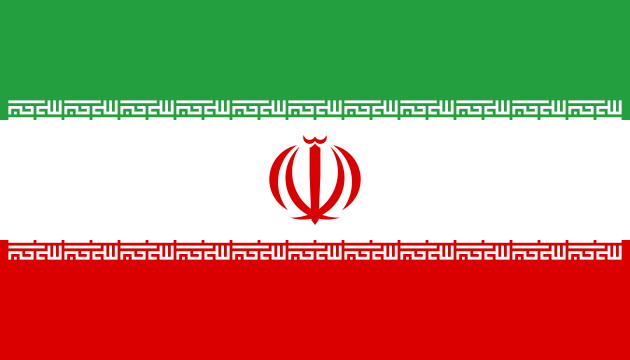
Adopted in 1980
| Capital | Tehran |
|---|---|
| Population | 91 567 738 inh. |
| Area | 1 745 150 km² |
| Population density | 52.5 inh./km² |
| Local time | --:-- |
| Language(s) | Persian |
| Political system | Islamic Republic |
| National motto | Independence, freedom, the Islamic Republic |
| National anthem | Sorude Melliye Jomhuriye Eslâmiye Irân |
| Currency | Iranian rial (IRR) |
| History | View timeline |
| Land borders | Armenia, Azerbaijan, Turkmenistan, Turkey, Iraq, Afghanistan, Pakistan |
| Maritime borders | Caspian Sea, Persian Gulf, Gulf of Oman |
The flag: history and symbolism
Flag History
The green, white and red tricolour was made official at the beginning of the 20th century, after the Constitutional Revolution of 1906, with the lion and sun emblem in the centre, an ancient symbol of Persia and its monarchy.
After the Islamic Revolution of 1979, the lion and sun emblem was removed. The new flag was adopted on 29 July 1980: it kept the three bands but bears in its centre a stylised red emblem designed by Hamid Nadimi.
The Constitution of the Islamic Republic describes the flag in Article 18: green, white and red, with the emblem of the Islamic Republic and the motto ‘Allahu Akbar’.
Meaning of Colours & Emblems
The elements of the Iranian flag have a precise meaning:
- Green: Islam, growth and hope.
- White: peace and freedom.
- Red: courage and the blood of the martyrs.
- Central emblem: a stylised calligraphy of the word ‘Allah’, whose shape also evokes a tulip, a flower associated in Iranian tradition with young people who died for their country.
Anecdotes & Fun Facts
The phrase ‘Allahu Akbar’ (‘God is the greatest’), written in Kufic calligraphy, is repeated 22 times along the green and red bands, 11 times on each. The number recalls 22 Bahman in the Iranian calendar (11 February 1979), the date of the revolution's victory.
The lion and sun emblem, used for several centuries, remains a symbol of pre-1979 Iran today, particularly among the Iranian diaspora.
The Iranian flag resembles that of Tajikistan, a Persian-speaking country, which also combines red, white and green, but in reverse order and with a golden crown in the centre.
Similar Flags Around the World

Sport and history
Frequently asked questions
What is the capital of Iran?
Tehran is the capital of Iran.
What do the colours of the flag of Iran mean?
The elements of the Iranian flag have a precise meaning: Green: Islam, growth and hope. White: peace and freedom. Red: courage and the blood of the martyrs. Central emblem: a stylised calligraphy of the word ‘Allah’, whose shape also evokes a tulip, a flower associated in Iranian tradition with young people who died for their country.
Which countries border Iran?
Iran shares land borders with: Armenia, Azerbaijan, Turkmenistan, Turkey, Iraq, Afghanistan, Pakistan.