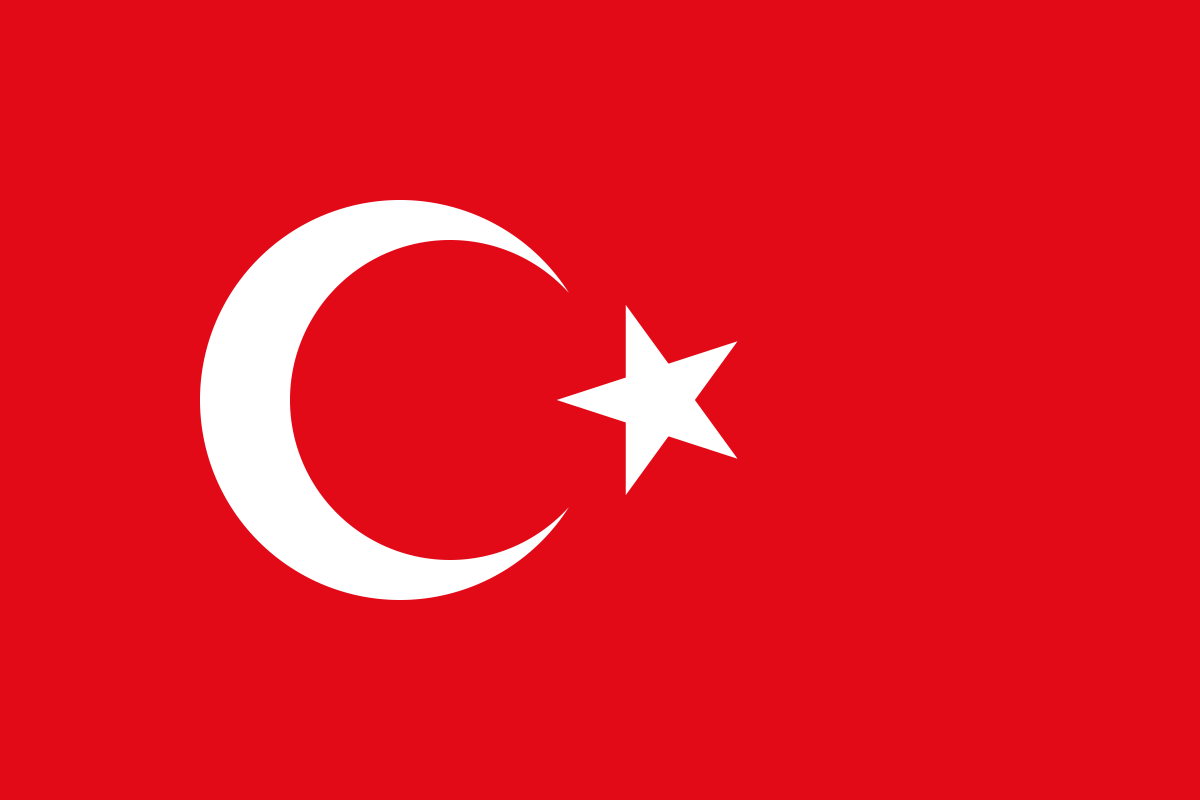
Adopted in 1844
| Capital | Ankara |
|---|---|
| Population | 85 518 661 inh. |
| Area | 785 350 km² |
| Population density | 108.9 inh./km² |
| Local time | --:-- |
| Language(s) | Turkish |
| Political system | Unitary parliamentary constitutional republic |
| National motto | Yurtta Sulh, Cihanda Sulh |
| National anthem | Istiklâl Marsi (The Independence March) |
| Currency | Turkish lira (TRY) |
| History | View timeline |
| Land borders | Greece, Bulgaria, Georgia, Armenia, Azerbaijan, Iran, Iraq, Syria |
| Maritime borders | Black Sea, Aegean Sea, Mediterranean Sea |
The flag: history and symbolism
Flag History
The Turkish flag is inherited from the Ottoman Empire. Red had been the colour of Ottoman banners for centuries, and the crescent gradually became the emblem of the Empire. At the end of the 18th century, under Selim III, the navy adopted a red ensign bearing a white crescent, to which a star was later added, first with eight points, then with five.
In 1844, as part of the Tanzimat reforms, the red flag with the white crescent and star became the national flag of the Ottoman Empire. The Republic of Turkey, proclaimed in 1923 by Mustafa Kemal Atatürk, retained it.
The Turkish Flag Law of 29 May 1936 set out its exact geometric proportions for the first time: the size and position of the crescent, the star and the space between them.
Meaning of Colours & Emblems
The Turkish flag has no detailed official symbolism, but its elements are rich in meaning:
- Red: it evokes the blood of the soldiers who died for the homeland, and it is the traditional colour of Turkish and Ottoman banners.
- Crescent and star: an ancient symbol, already used in Byzantium and by several ancient civilisations, associated with the Ottoman Empire and later with the Muslim world.
A popular legend has it that the flag was born from the reflection of the crescent moon and a star in a pool of blood on the evening of a victorious battle.
Anecdotes & Fun Facts
The Turkish flag holds a special place in the life of the country: it is ubiquitous on façades and in windows, and any insult to the flag is punishable under the Penal Code.
The flag of Tunisia closely resembles it, with its red crescent and star in a white disc on a red field, a legacy of the period when Tunisia was an autonomous province of the Ottoman Empire.
The crescent and star, spread by the Ottoman Empire, now appear on the flags of several countries, such as Algeria, Tunisia, Pakistan, Malaysia and Azerbaijan.
Similar Flags Around the World


Sport and history
National teams
Clubs
Competitions
Olympic Games
History
Historical figures
Frequently asked questions
What is the capital of Turkey?
Ankara is the capital of Turkey.
What do the colours of the flag of Turkey mean?
The Turkish flag has no detailed official symbolism, but its elements are rich in meaning: Red: it evokes the blood of the soldiers who died for the homeland, and it is the traditional colour of Turkish and Ottoman banners. Crescent and star: an ancient symbol, already used in Byzantium and by several ancient civilisations, associated with the Ottoman Empire and later with the Muslim world. A popular legend has it that the flag was born from the reflection of the crescent moon and a star in a pool of blood on the evening of a victorious battle.