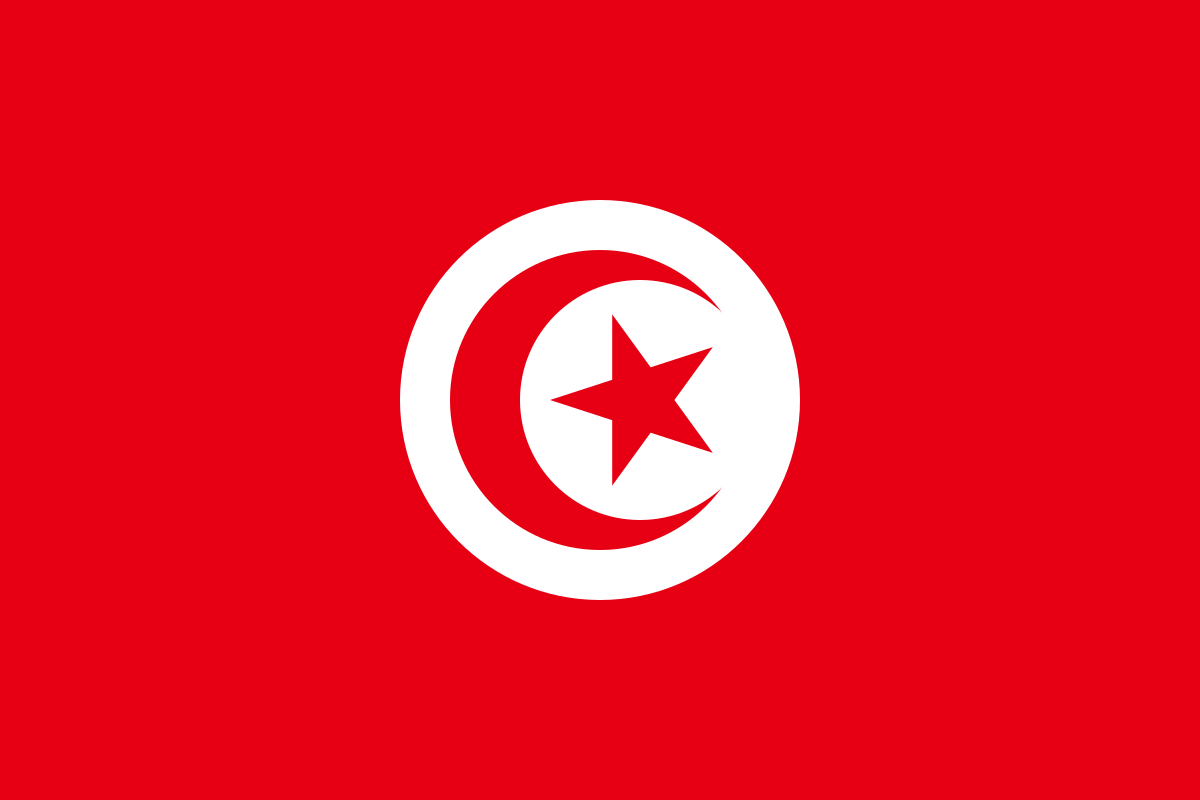
Adopted in 1827
| Capital | Tunis |
|---|---|
| Population | 12 277 109 inh. |
| Area | 163 610 km² |
| Population density | 75.0 inh./km² |
| Local time | --:-- |
| Language(s) | Arabic |
| Political system | Unitary semi-presidential republic |
| National motto | Horiya, nizam, adala (Liberty, Justice, Order) |
| National anthem | Humat Al-Hima (Defenders of the Homeland) |
| Currency | Tunisian dinar (TND) |
| History | View timeline |
| Land borders | Algeria, Libya |
| Maritime borders | Mediterranean Sea |
The flag: history and symbolism
Flag History
The Tunisian flag is one of the oldest in the Arab world. After the Battle of Navarino on 20 October 1827, in which the Tunisian fleet, fighting alongside the Ottoman fleet, was destroyed, Hussein II Bey decided to give Tunisia an ensign distinct from those of the other fleets of the Ottoman Empire.
The red flag with a white disc bearing a red crescent and star was adopted at that time; several sources date its official adoption to 1831. Tunisia celebrates its anniversary every 20 October.
It remained the country's flag under the French protectorate (1881-1956) and then of independent Tunisia. An organic law of 30 June 1999 set out its exact proportions and design for the first time.
Meaning of Colours & Emblems
The elements of the Tunisian flag are generally interpreted as follows:
- Red: the blood of the martyrs and resistance to oppression; it is also the colour of Ottoman banners.
- White disc: peace, or the sun.
- Crescent and star: traditional symbols of Islam, inherited from the Ottoman Empire, evoking the unity of all Muslims. The five points of the star are often associated with the five pillars of Islam.
Anecdotes & Fun Facts
The Tunisian flag closely resembles that of Turkey, with which it shares the red field, the crescent and the star, a sign of Tunisia's past as part of the Ottoman Empire. The central white disc sets it apart.
The Battle of Navarino, which led to the creation of the flag, pitted the Ottoman and Egyptian fleet against the British, French and Russian squadrons, which had come to support Greek independence.
The 1999 law even specifies the exact shade of the flag's red, defined by a colour chart reference.
Similar Flags Around the World

Sport and history
Frequently asked questions
What is the capital of Tunisia?
Tunis is the capital of Tunisia.
What do the colours of the flag of Tunisia mean?
The elements of the Tunisian flag are generally interpreted as follows: Red: the blood of the martyrs and resistance to oppression; it is also the colour of Ottoman banners. White disc: peace, or the sun. Crescent and star: traditional symbols of Islam, inherited from the Ottoman Empire, evoking the unity of all Muslims. The five points of the star are often associated with the five pillars of Islam.