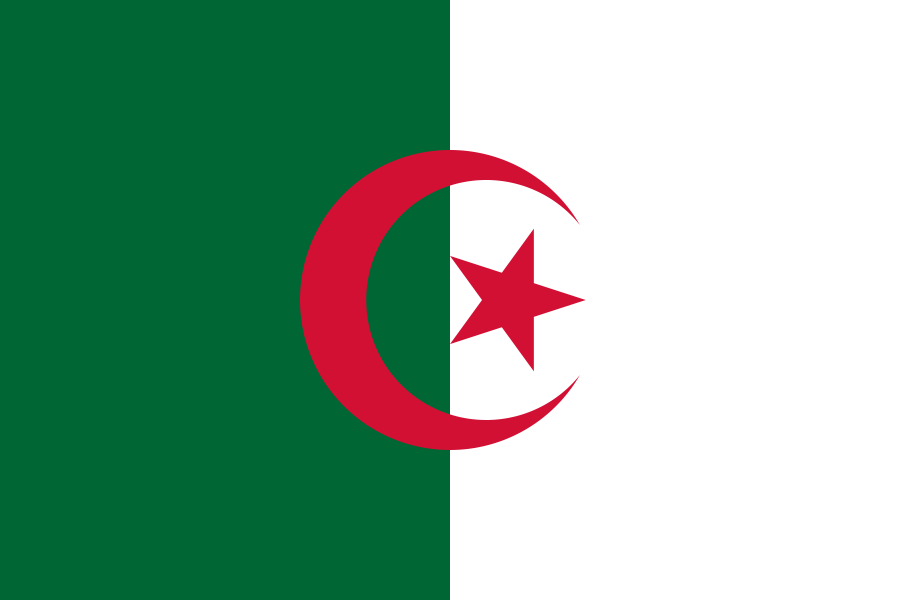
Adopted in 1962
| Capital | Algiers |
|---|---|
| Population | 46 814 308 inh. |
| Area | 2 381 740 km² |
| Population density | 19.7 inh./km² |
| Local time | --:-- |
| Language(s) | Arabic, Berber |
| Political system | Unitary semi-presidential people's republic |
| National motto | By the people and for the people |
| National anthem | Kassaman (We Pledge) |
| Currency | Algerian dinar (DZD) |
| History | View timeline |
| Land borders | Tunisia, Libya, Niger, Mali, Mauritania, Morocco |
| Maritime borders | Mediterranean Sea |
The flag: history and symbolism
Flag History
The Algerian flag has its origins in the nationalist movement of the 1930s. A green and white flag bearing a red crescent and star was adopted by the North African Star, then by Messali Hadj's Algerian People's Party. According to the most widespread tradition, the first one was sewn by Émilie Busquant, Messali Hadj's wife, in 1937.
During the War of Independence (1954-1962), this flag became that of the National Liberation Front and of the Provisional Government of the Algerian Republic, formed in 1958.
It became the national flag of independent Algeria in July 1962. A law of 25 April 1963 sets out its specifications, and the Constitution lists it among the symbols of the nation.
Meaning of Colours & Emblems
The elements of the Algerian flag are generally interpreted as follows:
- Green: Islam and hope, but also the land and prosperity.
- White: peace and the purity of the cause.
- Red crescent and star: traditional symbols of Islam; the red recalls the blood of those who died fighting for independence.
Anecdotes & Fun Facts
On 8 May 1945 in Sétif, during a demonstration held on the day of the Allied victory, the young scout Bouzid Saâl was shot dead while carrying the Algerian flag. His death marked the start of the Sétif, Guelma and Kherrata massacres.
The crescent on the Algerian flag is more closed than most crescents on the flags of Muslim countries. According to a frequently given explanation, longer horns are a sign of happiness.
Émilie Busquant, credited with making the first flag, was a French activist from Lorraine who became Messali Hadj's wife and companion in the struggle.
Flags of Neighbouring Countries


Sport and history
Frequently asked questions
What is the capital of Algeria?
Algiers is the capital of Algeria.
What do the colours of the flag of Algeria mean?
The elements of the Algerian flag are generally interpreted as follows: Green: Islam and hope, but also the land and prosperity. White: peace and the purity of the cause. Red crescent and star: traditional symbols of Islam; the red recalls the blood of those who died fighting for independence.