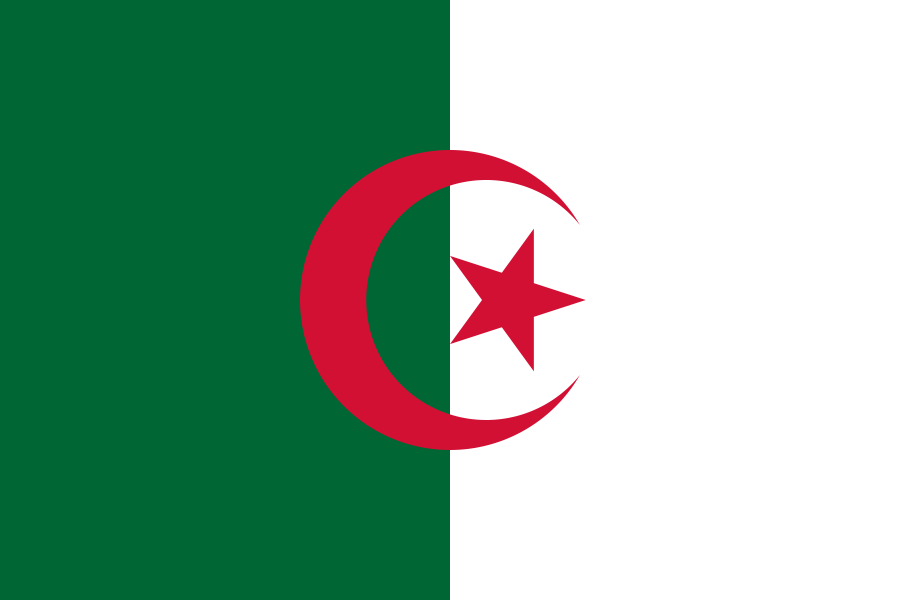
Algeria: timeline and key events
3rd century BC
-
Politics
Masinissa unites Numidia
An ally of Rome against Carthage at the Battle of Zama, the Berber leader Masinissa became king of all Numidia, with Cirta (present-day Constantine) as his capital. His long reign made the Numidian kingdom a major power in North Africa.
2nd century BC
-
War
End of the Jugurthine War
A grandson of Masinissa, the Numidian king Jugurtha held out against Rome for seven years. Handed over to the Romans by his father-in-law Bocchus, King of Mauretania, he died in captivity in Rome.
4th century
-
Religion
Birth of Saint Augustine in Thagaste
Augustine was born in Thagaste, present-day Souk Ahras, in Roman Africa. As Bishop of Hippo (Annaba), he became one of the most influential thinkers in Christianity; he died in 430 while the Vandals were besieging the city.
7th century
-
War
Arab conquest and the resistance of the Kahina
Around 700, Arab armies completed the conquest of the central Maghreb despite Berber resistance led by Kusaila and then by Queen Dihya, known as the Kahina. Islamisation, followed by gradual Arabisation, transformed the region permanently.
16th century
-
Politics
The Barbarossa brothers in Algiers
The corsair Oruç Barbarossa seized Algiers in 1516; his brother Hayreddin then placed the city under the suzerainty of the Ottoman sultan. The Regency of Algiers, largely autonomous, lasted until 1830.
19th century
-
Politics
The “fly-whisk incident”
During a dispute over debts unpaid by France, Dey Hussein struck the French consul Pierre Deval with his fly whisk. Paris imposed a naval blockade on Algiers and later cited the incident to justify the expedition of 1830.
-
War
France captures Algiers
Having landed at Sidi Ferruch on 14 June, the French army secured the surrender of Dey Hussein on 5 July. The capture of Algiers ended the Ottoman regency and began a period of French colonisation that would last 132 years.
-
War
Emir Abdelkader leads the resistance
Proclaimed emir by the tribes of the west, Abdelkader built a state and fought the French army for fifteen years. He surrendered in December 1847; a major figure in Algerian history, he is also remembered for protecting thousands of Christians in Damascus in 1860.
-
Politics
Algeria divided into French departments
The constitution of the Second Republic declared Algeria French territory, and three departments were created: Algiers, Oran and Constantine. European settlers were citizens, while the Muslim population remained under a separate status, codified in 1881 by the Code de l'indigénat.
-
War
Mokrani Revolt
The bachagha El Mokrani and the Rahmaniyya brotherhood roused much of Kabylia and eastern Algeria to revolt. After the uprising was crushed, vast tracts of land were confiscated for colonisation and many insurgents were deported to New Caledonia.
20th century
-
War
Sétif, Guelma and Kherrata massacres
On 8 May, the day of the Allied victory, a nationalist demonstration in Sétif turned into a riot in which around a hundred Europeans were killed. The repression by the army and settler militias left thousands dead; estimates range from 1,165, the official French figure at the time, to 45,000, the figure put forward by the Algerian authorities.
-
War
Start of the War of Independence
On the night of 1 November, the National Liberation Front (FLN) launched a series of coordinated attacks across Algeria. Known in France as the Algerian War and in Algeria as the War of National Liberation, the conflict pitted the FLN against the French army for nearly eight years, with violence against civilians on both sides.
-
War
Battle of Algiers
In response to FLN bombings in the capital, General Massu's paratroopers were granted full police powers and dismantled its networks. The use of torture, denounced at the time, was acknowledged by the French state in 2018, when it admitted that the mathematician Maurice Audin had died under torture.
-
Politics
Independence of Algeria
Following the Évian Accords of 18 March and the referendum of 1 July, independence was proclaimed on 5 July. The war had left several hundred thousand dead (one and a half million according to the Algerian authorities); nearly 800,000 Europeans left the country within a few months, and thousands of harkis, Algerian auxiliaries of the French army, fell victim to reprisals.
-
Politics
Houari Boumediene's coup
Colonel Houari Boumediene overthrew Ahmed Ben Bella, the first president of independent Algeria. He ruled the country until his death in 1978 under a one-party system led by the FLN, committed to socialism and non-alignment.
-
Economy
Nationalisation of oil and gas
Houari Boumediene announced the takeover of a 51% stake in French oil companies and the nationalisation of gas. Oil and gas, produced by Sonatrach, became the country's main source of revenue.
-
Politics
October 1988 riots
Youth riots fuelled by the economic crisis broke out in Algiers and then across the country; their repression left several hundred dead. The 1989 constitution ended one-party rule and opened the way to a multi-party system.
-
War
Elections halted and the Black Decade
With the Islamic Salvation Front (FIS) having come first in the first round of the legislative elections, the army halted the electoral process in January 1992. There followed a conflict between the security forces and armed Islamist groups that claimed between 100,000 and 200,000 lives, according to estimates.
-
Politics
Election of Abdelaziz Bouteflika
Elected president in April, Abdelaziz Bouteflika secured approval by referendum of a “civil concord” law, followed in 2005 by a Charter for Peace and National Reconciliation granting a partial amnesty to Islamist fighters. He was re-elected three times.
21st century
-
Politics
The Hirak
On 22 February, massive peaceful demonstrations broke out against Abdelaziz Bouteflika's bid for a fifth term. The president resigned on 2 April; Abdelmadjid Tebboune was elected in December in a vote marked by low turnout.