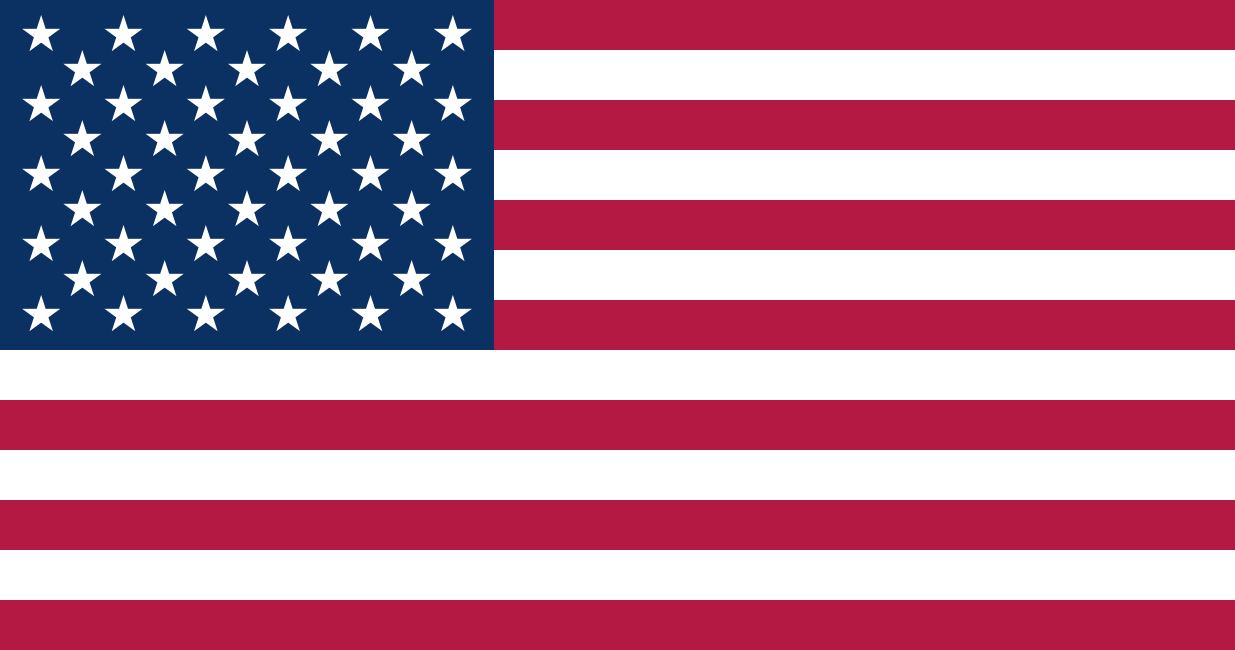
United States: timeline and key events
-
Politics
Founding of Jamestown
In 1607, English settlers founded Jamestown in Virginia, the first permanent English settlement in North America.
-
Politics
Declaration of Independence
On 4 July 1776, the thirteen American colonies declared independence from Britain, founding the United States of America.
-
Politics
Adoption of the Federal Constitution
The Philadelphia Convention adopted the United States Constitution, establishing a federal government with separation of powers.
-
Politics
Louisiana Purchase
The United States purchased the vast Louisiana territory from Napoleon for 15 million dollars, doubling the country's size.
-
War
Start of the Civil War
Eleven southern states seceded to form the Confederate States of America, triggering a bloody civil war that lasted until 1865.
-
Politics
Lincoln's Emancipation Proclamation
President Lincoln proclaimed the freedom of enslaved people in Confederate states, giving the Civil War a moral dimension.
-
Economy
Completion of the Transcontinental Railroad
The inauguration of the first transcontinental railroad at Promontory Summit connected the east and west coasts, transforming the American economy.
-
War
Spanish-American War
The United States declared war on Spain and gained Cuba, Puerto Rico and the Philippines, establishing itself as a world power.
-
War
Entry into World War I
Following Germany's unrestricted submarine warfare and the Zimmermann telegram, the United States entered the Great War on the side of the Allies.
-
Economy
Wall Street Crash and Great Depression
The collapse of the New York Stock Exchange in October 1929 triggered the Great Depression, causing mass unemployment in the United States and worldwide.
-
War
Attack on Pearl Harbor
On 7 December 1941, Japan's surprise attack on the naval base of Pearl Harbor brought the United States into World War II.
-
War
Atomic Bombs on Hiroshima and Nagasaki
The United States dropped atomic bombs on Hiroshima (6 August) and Nagasaki (9 August), leading to Japan's surrender and the end of World War II.
-
Politics
Brown v. Board of Education ruling
The Supreme Court ruled racial segregation in public schools unconstitutional, marking a turning point in the civil rights movement.
-
Politics
Assassination of President Kennedy
On 22 November 1963, President John F. Kennedy was assassinated in Dallas, Texas, plunging the country into deep national mourning.
-
Science
First steps on the Moon (Apollo 11)
On 20 July 1969, astronauts Neil Armstrong and Buzz Aldrin became the first humans to walk on the Moon during the Apollo 11 mission.
-
Politics
Nixon's resignation (Watergate scandal)
President Richard Nixon resigned under pressure from the Watergate scandal, the first resignation of a US president in history.
-
War
September 11 attacks
On 11 September 2001, terrorist attacks struck New York and Washington, killing nearly 3,000 people and transforming international politics.
-
Politics
Election of Barack Obama
Barack Obama was elected the 44th President of the United States, becoming the first African-American president in the country's history.