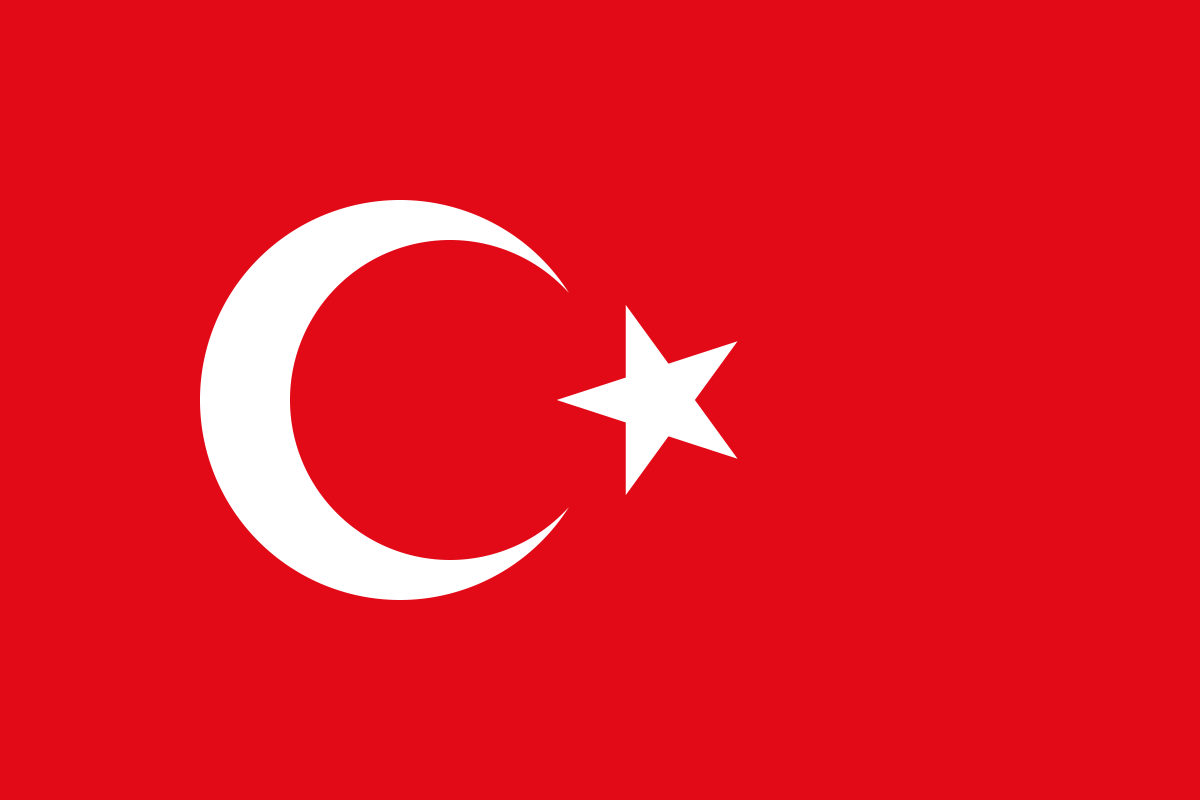
Turkey: timeline and key events
75th century BC
-
Culture
Çatalhöyük, first urban settlement
The Neolithic site of Çatalhöyük in central Anatolia is inhabited from 7500 BC with up to 8,000 inhabitants, representing one of the world's earliest examples of a dense and organized proto-city.
4th century BC
-
War
Alexander the Great conquers Anatolia
In 334 BC, Alexander the Great crosses the Hellespont and defeats the Persians at the Battle of the Granicus, paving the way for the rapid conquest of all of Anatolia and the Hellenization of the region.
4th century
-
Politics
Constantinople founded by Constantine
On May 11, 330, Emperor Constantine inaugurates his new capital on the site of Byzantium, renaming it Constantinople. This city on the Bosphorus becomes the center of Roman then Byzantine power for over a thousand years.
11th century
-
War
Seljuk victory at Manzikert, entry into Anatolia
On August 26, 1071, the Seljuk Turks of Alp Arslan crush the Byzantine army at Manzikert and capture Emperor Romanos IV, opening Anatolia to Turkish and Turco-Muslim settlement.
13th century
-
Politics
Foundation of the Ottoman Empire by Osman I
Around 1299, Osman I proclaims his independence from the Seljuks and founds the Ottoman state in Bithynia, beginning a dynasty that will build one of the most enduring and extensive empires in world history.
15th century
-
War
Fall of Constantinople, end of the Byzantine Empire
On May 29, 1453, Sultan Mehmed II captures Constantinople after a 53-day siege, ending the thousand-year Byzantine Empire. The city is renamed Istanbul and becomes the capital of the Ottoman Empire.
16th century
-
Politics
Reign of Suleiman the Magnificent, Ottoman apogee
The reign of Suleiman I (1520-1566) marks the apogee of the Ottoman Empire: he extends its borders from the gates of Vienna to Baghdad, reforms the laws (Kanun), and makes Constantinople the cultural center of the Islamic world.
17th century
-
War
Siege of Vienna, beginning of Ottoman retreat
The siege of Vienna in September 1683 ends in an Ottoman defeat against the Polish-Austrian forces of King John III Sobieski, marking the beginning of the slow loss of the Empire's European territories.
19th century
-
Politics
Abolition of the Janissaries, military modernization
In June 1826, Sultan Mahmud II abolishes the Janissary corps in the Auspicious Incident (Vaka-i Hayriye), eliminating the main force opposing reforms and committing the Ottoman Empire to modernization.
20th century
-
Politics
Young Turks Revolution
In July 1908, the Committee of Union and Progress forces Sultan Abdülhamid II to restore the Constitution of 1876, triggering a constitutional revolution that transforms the Ottoman Empire into a parliamentary monarchy.
-
War
Armenian Genocide
From April 1915, the Young Turks government organizes the systematic deportation and massacre of the Armenian population of the Ottoman Empire, killing between 600,000 and 1.5 million people according to estimates.
-
War
Turkish War of Independence led by Mustafa Kemal
In May 1919, Mustafa Kemal lands at Samsun and organizes resistance against Greek, Armenian, French, and British occupation, leading a victorious war that lasts until 1922 and reshapes Anatolia.
-
Politics
Proclamation of the Turkish Republic
On October 29, 1923, Mustafa Kemal Atatürk proclaims the Republic of Turkey, becoming its first president. He launches a radical modernizing revolution: Latin alphabet, secularism, women's rights, new civil code.
-
Politics
Turkish women gain the right to vote
In December 1934, Turkey grants women the right to vote and stand for election in legislative elections, ahead of many European countries, a direct consequence of Atatürk's modernizing reforms.
-
Politics
Turkey joins NATO
On February 18, 1952, Turkey becomes a member of the North Atlantic Treaty Organization, anchoring itself in the Western bloc during the Cold War and reinforcing its strategic role between Europe and Asia.
-
War
Turkish military intervention in Cyprus
On July 20, 1974, Turkey intervenes militarily in Cyprus in response to the pro-Greek coup, occupying the northern part of the island. This partition persists to this day and remains an obstacle to Turkey's EU membership.
-
Politics
Military coup d'état
On September 12, 1980, the Turkish armed forces overthrow the civilian government in a coup that suspends the Constitution, dissolves political parties, and imprisons thousands of opponents.
-
Other
Izmit earthquake, 17,000 deaths
The earthquake of August 17, 1999 (magnitude 7.6) strikes the industrial region of Kocaeli, officially killing 17,000 people and injuring 44,000, revealing serious failures in earthquake-resistant construction in Turkey.
21st century
-
Politics
Coup attempt, mass purges
On the night of July 15-16, 2016, a military faction attempts to overthrow Erdogan's government. The coup fails but triggers mass purges: 150,000 people arrested or dismissed from the military, judiciary, education, and media.