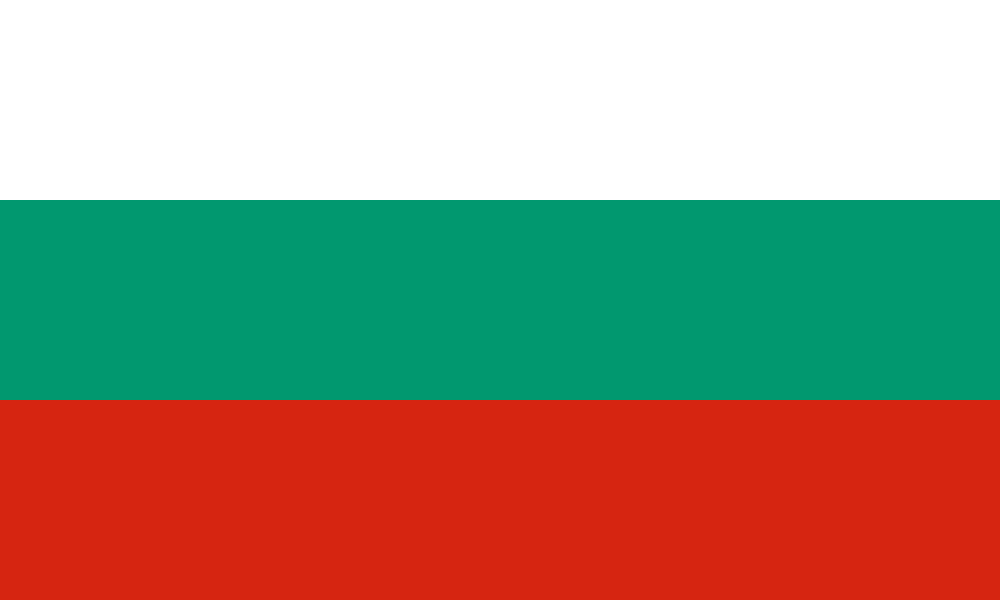
Adopted in 1990
| Capital | Sofia |
|---|---|
| Population | 6 444 366 inh. |
| Area | 111 000 km² |
| Population density | 58.1 inh./km² |
| Local time | --:-- |
| Language(s) | Bulgarian |
| Political system | Unitary parliamentary republic |
| National motto | Unity makes strength |
| National anthem | Mila Rodino |
| Currency | Euro (EUR) |
| Land borders | Greece, Turkey, Romania, Serbia, Macédoine |
| Maritime borders | Black Sea |
The flag: history and symbolism
Flag History
The Bulgarian flag was born after the country's liberation from Ottoman rule at the end of the Russo-Turkish War of 1877-1878. On 16 April 1879, the Constituent Assembly meeting in Tarnovo wrote it into Bulgaria's first Constitution: three horizontal stripes, white, green and red.
The design is inspired by the Russian flag, with green replacing blue. During the communist period, the arms of the People's Republic appeared in the canton.
The flag regained its original form, without an emblem, after the fall of the communist regime in 1990. The 1991 Constitution gives its description.
Meaning of Colours & Emblems
The colours of the Bulgarian flag are generally interpreted as follows:
- White: peace, freedom and the generosity of the Bulgarian people.
- Green: the fertility of the land, the forests and agriculture, long at the heart of the country's economy.
- Red: courage and the blood shed for independence.
Anecdotes & Fun Facts
The Samara flag, embroidered in 1876 in the Russian city of Samara and presented in 1877 to the Bulgarian volunteers fighting alongside the Russian army, is one of the most revered symbols of Bulgaria's liberation.
The Bulgarian flag is one of the few European flags to include green, like those of Ireland, Italy, Portugal, Hungary, Lithuania and Belarus.
The Bulgarian flag resembles that of Hungary, which also combines white, green and red, but in the order red, white and green.
Similar Flags Around the World

Sport and history
National teams
Olympic Games
Frequently asked questions
What is the capital of Bulgaria?
Sofia is the capital of Bulgaria.
What do the colours of the flag of Bulgaria mean?
The colours of the Bulgarian flag are generally interpreted as follows: White: peace, freedom and the generosity of the Bulgarian people. Green: the fertility of the land, the forests and agriculture, long at the heart of the country's economy. Red: courage and the blood shed for independence.