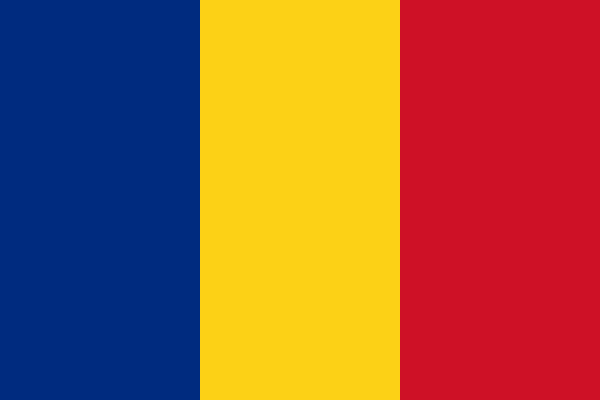
Adopted in 1989
| Capital | Bucharest |
|---|---|
| Population | 19 069 340 inh. |
| Area | 238 400 km² |
| Population density | 80.0 inh./km² |
| Local time | --:-- |
| Language(s) | Romanian |
| Political system | Unitary semi-presidential republic |
| National anthem | Desteapta-te, române! (Awaken thee, Romanian!) |
| Currency | Romanian leu (RON) |
| Land borders | Hungary, Ukraine, Moldova, Bulgaria, Serbia |
| Maritime borders | Black Sea |
The flag: history and symbolism
Flag History
Blue, yellow and red appeared together in the 19th century in the Danubian Principalities. During the revolution of 1848, the insurgents in Wallachia adopted a tricolour with horizontal stripes bearing the motto ‘Justice, Brotherhood’.
After the union of Moldavia and Wallachia, achieved in 1859 under Prince Alexandru Ioan Cuza, the United Principalities adopted these three colours. The Constitution of 1866 set the stripes vertically: blue at the hoist, then yellow and red.
Under the communist regime, the flag bore in its centre the arms of the People's Republic, and later of the Socialist Republic. They disappeared with the revolution of December 1989, and the 1991 Constitution describes the current flag in Article 12.
Meaning of Colours & Emblems
The most widespread interpretation follows the ideals of the revolutionaries of 1848:
- Blue: liberty, and the sky.
- Yellow: justice, and the riches of the land.
- Red: brotherhood, and the blood shed for the homeland.
The tricolour also expresses the unity of the historic Romanian provinces, whose arms combined these colours.
Anecdotes & Fun Facts
During the revolution of December 1989, demonstrators cut the communist arms out of the centre of their flags. The ‘flag with a hole’ became the symbol of the fall of Nicolae Ceaușescu's regime.
The Romanian flag is almost identical to that of Chad, which differs only by a darker shade of blue. In 2004, Chad raised the matter at the United Nations; Romania replied that it would not change its flag, which had been in use long before Chad's independence.
The flag of Moldova, a neighbouring Romanian-speaking country, uses the same colours, with an eagle bearing the Moldovan arms in the centre.
Similar Flags Around the World


Sport and history
Athletes
Clubs
Olympic Games
Frequently asked questions
What is the capital of Romania?
Bucharest is the capital of Romania.
What do the colours of the flag of Romania mean?
The most widespread interpretation follows the ideals of the revolutionaries of 1848: Blue: liberty, and the sky. Yellow: justice, and the riches of the land. Red: brotherhood, and the blood shed for the homeland. The tricolour also expresses the unity of the historic Romanian provinces, whose arms combined these colours.