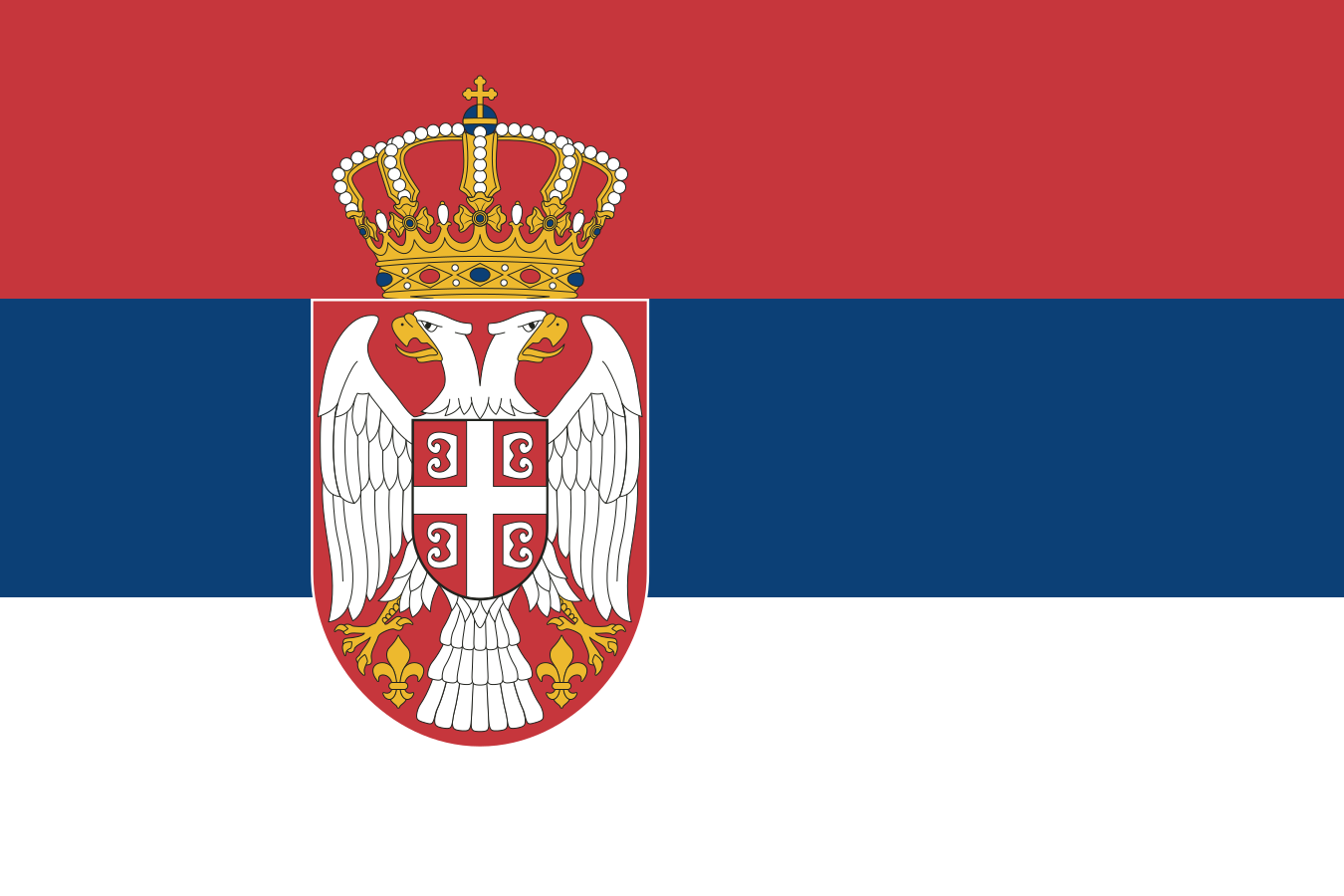
Adopted in 2004
| Capital | Belgrade |
|---|---|
| Population | 6 587 202 inh. |
| Area | 84 990 km² |
| Population density | 77.5 inh./km² |
| Local time | --:-- |
| Language(s) | Serbian |
| Political system | Unitary parliamentary constitutional republic |
| National anthem | Boze Pravde (God of Justice) |
| Currency | Serbian dinar (RSD) |
| Land borders | Bosnia and Herzegovina, Croatia, Hungary, Romania, Bulgaria, Macédoine, Kosovo, Montenegro |
The flag: history and symbolism
Flag History
The first Serbian flag was provided for as early as 1835 by the Sretenje Constitution, the country's first constitution, adopted during the struggle for autonomy from the Ottoman Empire. Red, blue and white then became established and remained the flag of Serbia until 1918.
Serbia then became part of Yugoslavia. The red, blue and white tricolour became its flag again within Serbia and Montenegro: the current design, with the coat of arms, dates from 2004 and was slightly revised in 2010.
Serbia kept this flag after its separation from Montenegro in 2006. The civil flag has only the three stripes.
Meaning of Colours & Emblems
The elements of the Serbian flag are generally interpreted as follows:
- Red, blue and white: the pan-Slavic colours, shared with several Slavic nations; a popular reading sees in them the blood shed, the sky and purity.
- White double-headed eagle: inherited from the medieval Nemanjić dynasty, it recalls the link with Byzantium.
- Cross and four firesteels: according to a popular interpretation, the four C-shaped motifs stand for the motto ‘Only unity saves the Serbs’.
Anecdotes & Fun Facts
15 February, Serbia's Statehood Day, commemorates both the start of the First Serbian Uprising in 1804 and the adoption of the Sretenje Constitution in 1835.
The Serbian flag has the same colours as that of Russia, but in reverse order: it is sometimes described as the Russian flag upside down.
It also resembles those of Slovenia, Slovakia and Croatia, which combine the same pan-Slavic colours with their own coats of arms.
Similar Flags Around the World


Sport and history
National teams
Athletes
Clubs
Olympic Games
Frequently asked questions
What is the capital of Serbia?
Belgrade is the capital of Serbia.
What do the colours of the flag of Serbia mean?
The elements of the Serbian flag are generally interpreted as follows: Red, blue and white: the pan-Slavic colours, shared with several Slavic nations; a popular reading sees in them the blood shed, the sky and purity. White double-headed eagle: inherited from the medieval Nemanjić dynasty, it recalls the link with Byzantium. Cross and four firesteels: according to a popular interpretation, the four C-shaped motifs stand for the motto ‘Only unity saves the Serbs’.
Which countries border Serbia?
Serbia shares land borders with: Bosnia and Herzegovina, Croatia, Hungary, Romania, Bulgaria, Macédoine, Kosovo, Montenegro.