Adopted in 2004
| Capital | Podgorica |
|---|---|
| Population | 623 831 inh. |
| Area | 13 810 km² |
| Population density | 45.2 inh./km² |
| Local time | --:-- |
| Language(s) | Montenegrin |
| Political system | Parliamentary republic |
| National anthem | Oj, svijetla majska zoro (Oh, Bright Dawn of May) |
| Currency | Euro (EUR) |
| Land borders | Croatia, Bosnia and Herzegovina, Serbia, Kosovo, Albania |
| Maritime borders | Adriatic Sea |
The flag: history and symbolism
Flag History
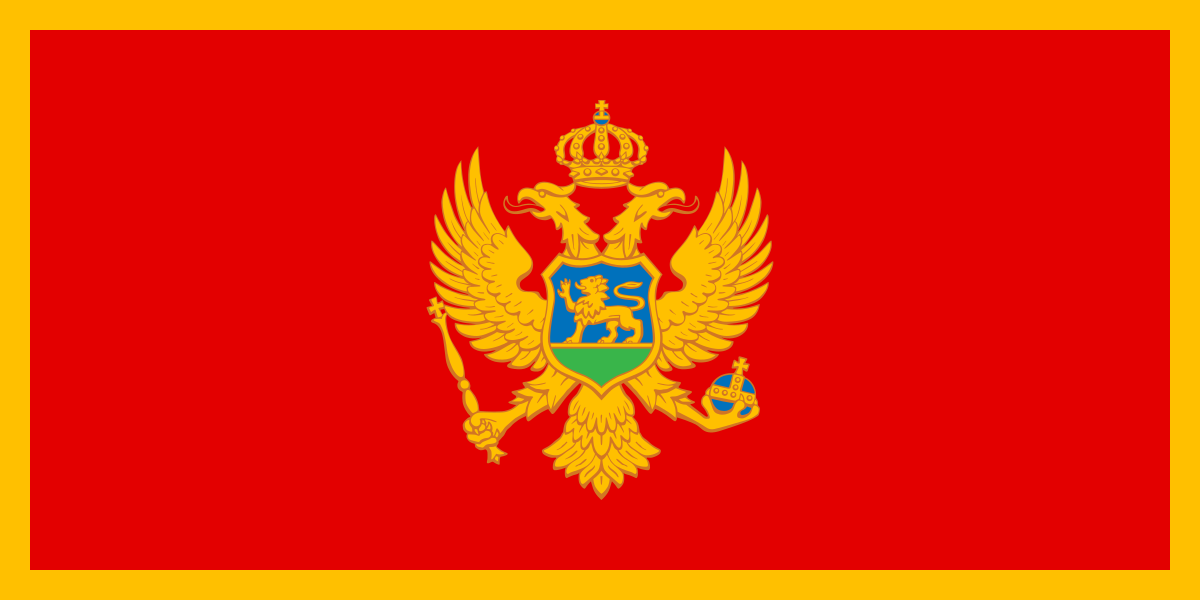
Red and gold are the traditional colours of the Petrović-Njegoš dynasty, which ruled Montenegro until 1918. The red banners of the prince-bishops, and later of King Nicholas I, already bore the double-headed eagle.
Within Yugoslavia, and then in the federation formed with Serbia, Montenegro first used a red, blue and white tricolour. The law on state symbols of 13 July 2004 adopted the current flag: a red field with a gold border, bearing the coat of arms in the centre.
Montenegro became independent after the referendum of 21 May 2006 and kept this flag, which breaks with the pan-Slavic tricolour it had shared with Serbia.
Meaning of Colours & Emblems
The elements of the Montenegrin flag refer to the country's history:
- Red and gold: the colours of the Petrović-Njegoš dynasty and of the old Montenegrin banners.
- Double-headed eagle: inherited from Byzantium, it symbolises the union of Church and State, long combined in the person of the prince-bishops.
- Lion: placed on the eagle's shield, it is associated with the episcopal authority of the former rulers.
Anecdotes & Fun Facts
13 July, the date the flag was adopted, is also Montenegro's Statehood Day: it commemorates the recognition of Montenegro's independence at the Congress of Berlin in 1878.
The gold border framing the red field is a rare feature among national flags.
The flag recalls that of neighbouring Albania, which is also red with a double-headed eagle, but the Montenegrin eagle is golden and crowned.
Similar Flags Around the World

Sport and history
Olympic Games
Frequently asked questions
What is the capital of Montenegro?
Podgorica is the capital of Montenegro.
What do the colours of the flag of Montenegro mean?
The elements of the Montenegrin flag refer to the country's history: Red and gold: the colours of the Petrović-Njegoš dynasty and of the old Montenegrin banners. Double-headed eagle: inherited from Byzantium, it symbolises the union of Church and State, long combined in the person of the prince-bishops. Lion: placed on the eagle's shield, it is associated with the episcopal authority of the former rulers.
Which countries border Montenegro?
Montenegro shares land borders with: Croatia, Bosnia and Herzegovina, Serbia, Kosovo, Albania.