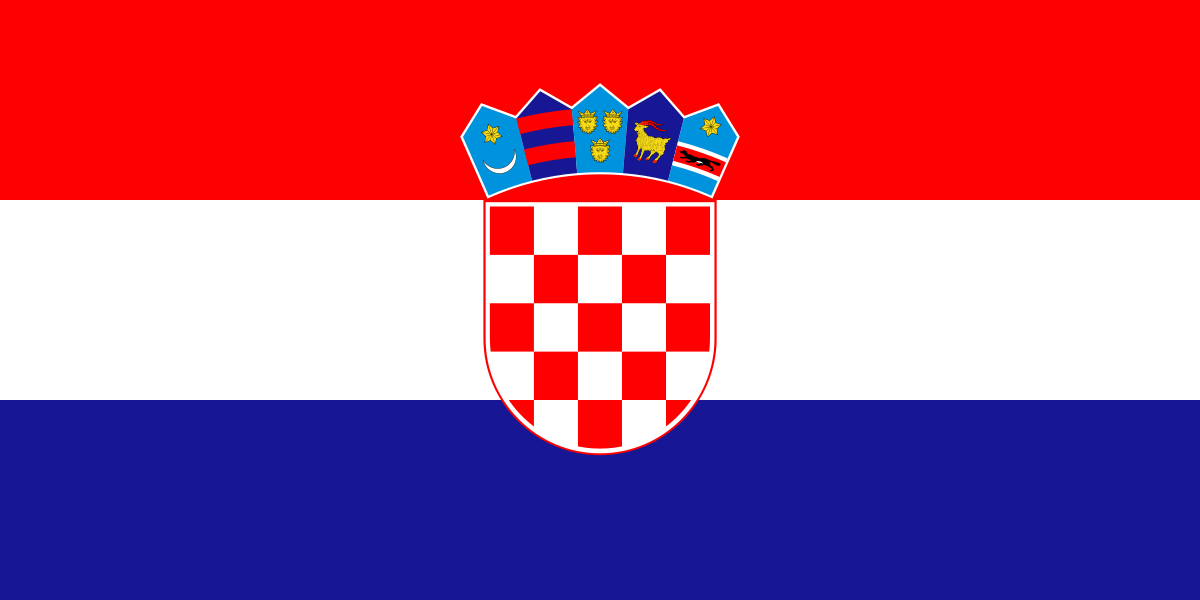
Adopted in 1990
| Capital | Zagreb |
|---|---|
| Population | 3 866 300 inh. |
| Area | 88 070 km² |
| Population density | 43.9 inh./km² |
| Local time | --:-- |
| Language(s) | Croatian |
| Political system | Unitary parliamentary constitutional republic |
| National anthem | Lijepa nasa domovino (Our Beautiful Homeland) |
| Currency | Euro (EUR) |
| Land borders | Slovenia, Hungary, Serbia, Bosnia and Herzegovina, Montenegro |
| Maritime borders | Adriatic Sea |
The flag: history and symbolism
Flag History
The Croatian flag combines two legacies. The red and white chequerboard (šahovnica), the emblem of Croatia, has been attested since at least the end of the 15th century: one of its oldest known depictions is found in Innsbruck, on a decoration dated 1495.
The red, white and blue tricolour appeared during the revolution of 1848, under the authority of Ban Josip Jelačić. During the Yugoslav period, the Socialist Republic of Croatia used this tricolour with a red star.
The current flag was adopted on 21 December 1990, a few months before independence was declared in 1991. It bears in its centre the coat of arms of Croatia: the chequerboard, topped by a crown of five small shields.
Meaning of Colours & Emblems
The elements of the Croatian flag sum up the history of the country's regions:
- Red, white and blue: the pan-Slavic colours, popularised in the 19th century and shared by several Slavic nations.
- Chequerboard: made up of 25 squares, 13 red and 12 white, it begins with a red square in the top left corner.
- Crown: its five shields represent ancient Croatia, the Republic of Ragusa (Dubrovnik), Dalmatia, Istria and Slavonia.
Anecdotes & Fun Facts
The chequerboard has become one of the most recognisable emblems in world sport thanks to the shirt of the Croatian national football team, runners-up at the 2018 World Cup.
The shield of Istria shows a goat, that of Dalmatia three crowned leopards' heads, and that of Slavonia a marten running between two rivers, the Sava and the Drava.
The Croatian tricolour resembles the flags of Slovenia, Slovakia, Russia and the Netherlands, but its central chequerboard makes it instantly recognisable.
Similar Flags Around the World


Sport and history
National teams
Athletes
Clubs
Olympic Games
Frequently asked questions
What is the capital of Croatia?
Zagreb is the capital of Croatia.
What do the colours of the flag of Croatia mean?
The elements of the Croatian flag sum up the history of the country's regions: Red, white and blue: the pan-Slavic colours, popularised in the 19th century and shared by several Slavic nations. Chequerboard: made up of 25 squares, 13 red and 12 white, it begins with a red square in the top left corner. Crown: its five shields represent ancient Croatia, the Republic of Ragusa (Dubrovnik), Dalmatia, Istria and Slavonia.
Which countries border Croatia?
Croatia shares land borders with: Slovenia, Hungary, Serbia, Bosnia and Herzegovina, Montenegro.