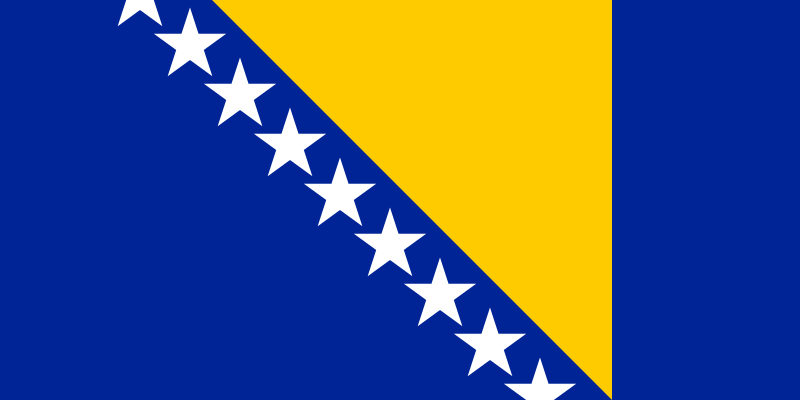
Adopted in 1998
| Capital | Sarajevo |
|---|---|
| Population | 3 164 253 inh. |
| Area | 51 210 km² |
| Population density | 61.8 inh./km² |
| Local time | --:-- |
| Language(s) | Bosnian, Serbian, Croatian |
| Political system | Federal parliamentary republic |
| National anthem | Intermeco |
| Currency | Bosnia and Herzegovina convertible mark (BAM) |
| Land borders | Croatia, Serbia, Montenegro |
| Maritime borders | Adriatic Sea |
The flag: history and symbolism
Flag History
After independence was declared in 1992, the Republic of Bosnia and Herzegovina used a white flag bearing a blue shield with fleurs-de-lis, inspired by the arms of the medieval Kotromanić dynasty.
The Dayton Agreement ended the war in 1995, but the representatives of the country's three peoples could not agree on a new flag. The international High Representative, Carlos Westendorp, imposed the current flag by decision, and it was raised for the first time on 4 February 1998.
The flag had to be ready for the Nagano Winter Olympics, which opened a few days later, so that the country's team could march under a common emblem.
Meaning of Colours & Emblems
The flag was designed to belong to none of the country's three communities:
- Yellow triangle: it evokes the shape of the territory and the equality of the three constituent peoples, Bosniaks, Croats and Serbs.
- Blue and white stars: they are inspired by the European flag and express the country's aspiration to join Europe.
The colours were chosen for their neutrality: none of them is associated with any one community.
Anecdotes & Fun Facts
There are nine stars along the triangle: seven whole ones and two cut in half, at the top and bottom, as if the row continued indefinitely.
The 1992 flag with fleurs-de-lis is still used by some Bosniaks, not least in the stands, as a symbol of the country's defence during the war.
Bosnia and Herzegovina is one of the few countries whose flag was imposed by an international authority rather than adopted by its own institutions.
Flags of Neighbouring Countries


Sport and history
National teams
Olympic Games
Frequently asked questions
What is the capital of Bosnia and Herzegovina?
Sarajevo is the capital of Bosnia and Herzegovina.
What do the colours of the flag of Bosnia and Herzegovina mean?
The flag was designed to belong to none of the country's three communities: Yellow triangle: it evokes the shape of the territory and the equality of the three constituent peoples, Bosniaks, Croats and Serbs. Blue and white stars: they are inspired by the European flag and express the country's aspiration to join Europe. The colours were chosen for their neutrality: none of them is associated with any one community.
Which countries border Bosnia and Herzegovina?
Bosnia and Herzegovina shares land borders with: Croatia, Serbia, Montenegro.