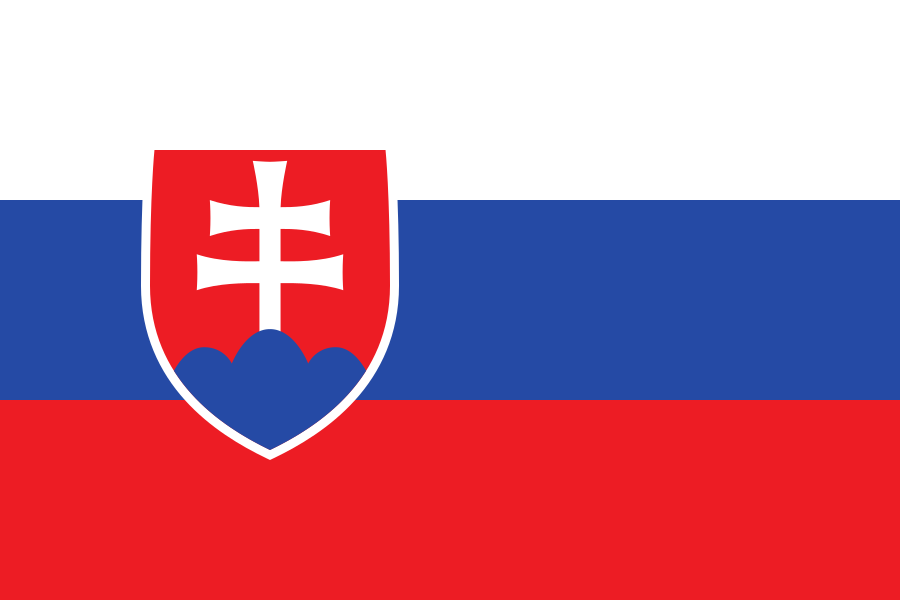
Adopted in 1992
| Capital | Bratislava |
|---|---|
| Population | 5 422 069 inh. |
| Area | 49 030 km² |
| Population density | 110.6 inh./km² |
| Local time | --:-- |
| Language(s) | Slovak |
| Political system | Parliamentary republic |
| National anthem | Nad Tatrou sa blyska (Lightning Over the Tatras) |
| Currency | Euro (EUR) |
| Land borders | Poland, Ukraine, Hungary, Austria, Czech Republic |
The flag: history and symbolism
Flag History
White, blue and red were adopted as the Slovak colours during the revolution of 1848, in reference to the pan-Slavic colours. The tricolour was used by the Slovak national movement throughout the 19th century.
During the Czechoslovak period, Slovakia used the common flag of Czechoslovakia. The Slovak tricolour served as the flag of the Slovak State from 1939 to 1945, then reappeared after the Velvet Revolution of 1989.
The current flag, with the coat of arms placed towards the hoist, was adopted on 3 September 1992, a few months before Slovakia became independent on 1 January 1993.
Meaning of Colours & Emblems
The elements of the Slovak flag are steeped in history:
- White, blue and red: the pan-Slavic colours, shared with several Slavic nations.
- White double cross: inherited from the Byzantine Christian tradition, it is associated with Saints Cyril and Methodius, who brought Christianity to the Slavs in the 9th century.
- Three blue hills: they traditionally represent three mountain ranges, the Tatras, the Fatra and the Mátra.
Anecdotes & Fun Facts
The coat of arms was added to the tricolour partly to distinguish the Slovak flag from that of Russia, which has the same colours in the same order.
The double cross on three hills also appears on the Slovak 1 and 2 euro coins.
The Slovak flag also resembles that of Slovenia, whose coat of arms is placed in the upper corner at the hoist.
Similar Flags Around the World


Sport and history
National teams
Athletes
Olympic Games
Frequently asked questions
What is the capital of Slovakia?
Bratislava is the capital of Slovakia.
What do the colours of the flag of Slovakia mean?
The elements of the Slovak flag are steeped in history: White, blue and red: the pan-Slavic colours, shared with several Slavic nations. White double cross: inherited from the Byzantine Christian tradition, it is associated with Saints Cyril and Methodius, who brought Christianity to the Slavs in the 9th century. Three blue hills: they traditionally represent three mountain ranges, the Tatras, the Fatra and the Mátra.
Which countries border Slovakia?
Slovakia shares land borders with: Poland, Ukraine, Hungary, Austria, Czech Republic.