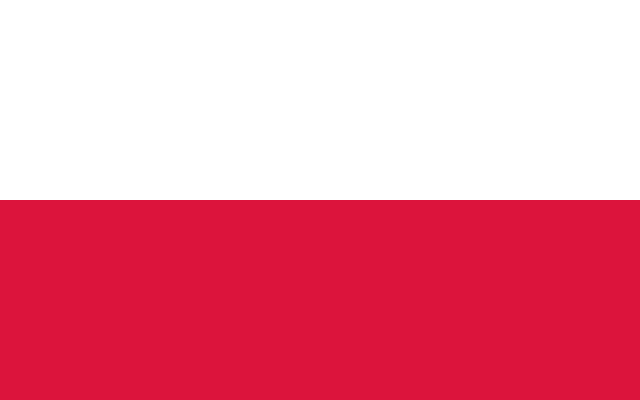
Adopted in 1919
| Capital | Warsaw |
|---|---|
| Population | 36 554 707 inh. |
| Area | 312 720 km² |
| Population density | 116.9 inh./km² |
| Local time | --:-- |
| Language(s) | Polish |
| Political system | Unitary parliamentary republic |
| National anthem | Mazurek Dabrowskiego (Dabrowski's Mazurka) |
| Currency | Polish zloty (PLN) |
| History | View timeline |
| Land borders | Russia, Lithuania, Belarus, Ukraine, Slovakia, Czech Republic, Germany |
| Maritime borders | Baltic Sea |
The flag: history and symbolism
Flag History
The white and red of the Polish flag come from the country's coat of arms: a crowned white eagle on a red field, the emblem of Poland since the Middle Ages. The white eagle already appears on the seal of Przemysł II, crowned king in 1295.
On 3 May 1792, the first anniversary of the Constitution of 3 May 1791, those taking part in the celebrations wore white and red cockades. During the November Uprising, the Sejm of the Kingdom of Poland adopted white and red as the national colours on 7 February 1831.
After independence was restored in 1918, the Sejm of the Second Republic officially adopted the white and red flag on 1 August 1919. Its current specifications are set out in the law of 31 January 1980 on the coat of arms, colours and anthem of the Republic of Poland.
Meaning of Colours & Emblems
The colours of the Polish flag are taken directly from the national coat of arms, in accordance with the rules of heraldry:
- White: the white eagle, placed at the top because the charge takes precedence over the field.
- Red: the field of the shield on which the eagle appears.
Over time, other interpretations have been added: white is often associated with peace and purity, and red with the blood shed for the country's independence.
Anecdotes & Fun Facts
Polish Flag Day, established in 2004, is celebrated on 2 May. The date recalls in particular the white and red flag raised by Polish soldiers on the Victory Column in Berlin on 2 May 1945.
The Polish flag resembles those of Indonesia and Monaco, which are red over white, the reverse arrangement. It also shares its colours with Switzerland, Denmark and Japan.
There is an official variant of the flag bearing the white eagle in the centre of the white stripe. Its use is reserved for, among others, diplomatic missions, civil airports and ships abroad.
Similar Flags Around the World


Sport and history
Athletes
Olympic Games
History
Historical figures
Frequently asked questions
What is the capital of Poland?
Warsaw is the capital of Poland.
What do the colours of the flag of Poland mean?
The colours of the Polish flag are taken directly from the national coat of arms, in accordance with the rules of heraldry: White: the white eagle, placed at the top because the charge takes precedence over the field. Red: the field of the shield on which the eagle appears. Over time, other interpretations have been added: white is often associated with peace and purity, and red with the blood shed for the country's independence.