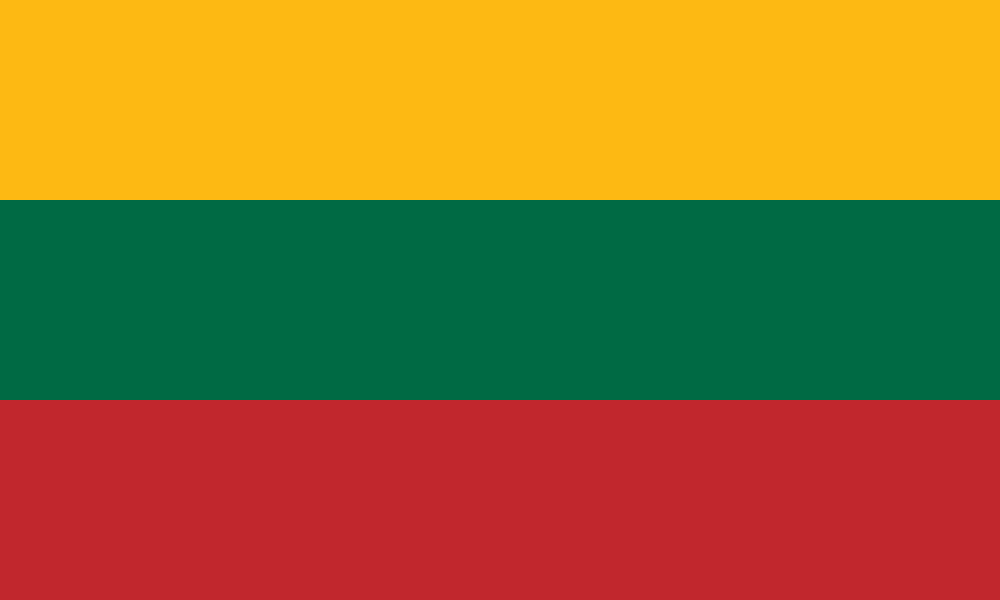
Adopted in 1918
| Capital | Vilnius |
|---|---|
| Population | 2 888 055 inh. |
| Area | 65 286 km² |
| Population density | 44.2 inh./km² |
| Local time | --:-- |
| Language(s) | Lithuanian |
| Political system | Unitary semi-presidential constitutional republic |
| National motto | Vienybe tezydi |
| National anthem | Tautiska giesme (National Hymn) |
| Currency | Euro (EUR) |
| Land borders | Poland, Belarus, Latvia, Russia |
| Maritime borders | Baltic Sea |
The flag: history and symbolism
Flag History
The yellow, green and red flag was chosen in 1918, when Lithuania declared its independence, by a commission whose members included the artist Antanas Žmuidzinavičius and the archaeologist Tadas Daugirdas. The colours were inspired by traditional Lithuanian textiles.
Banned after the country's annexation by the Soviet Union in 1940, the tricolour reappeared with the Sąjūdis national movement: on 7 October 1988, it was raised on Gediminas Tower in Vilnius. Lithuania declared the restoration of its independence on 11 March 1990.
A law of 2004 changed the flag's proportions from 1:2 to 3:5 and recognised the historical flag with the white knight (Vytis) on a red field as the state flag.
Meaning of Colours & Emblems
The colours of the Lithuanian flag are generally interpreted as follows:
- Yellow: the sun, light and prosperity.
- Green: the forests and fields, symbols of life and hope.
- Red: courage and the blood shed for the homeland.
Anecdotes & Fun Facts
The historical flag with the white knight, the Vytis, was that of the Grand Duchy of Lithuania, one of the largest states in Europe in the 15th century. Today it flies beside the national flag on several official buildings.
The Lithuanian flag is one of the few in Europe to use yellow and green, colours more common on African flags.
Lithuania's basketball players, Olympic medallists several times since 1992, have made these colours one of the best-known emblems of Lithuanian sport.
Similar Flags Around the World


Sport and history
Athletes
Olympic Games
Frequently asked questions
What is the capital of Lithuania?
Vilnius is the capital of Lithuania.
What do the colours of the flag of Lithuania mean?
The colours of the Lithuanian flag are generally interpreted as follows: Yellow: the sun, light and prosperity. Green: the forests and fields, symbols of life and hope. Red: courage and the blood shed for the homeland.