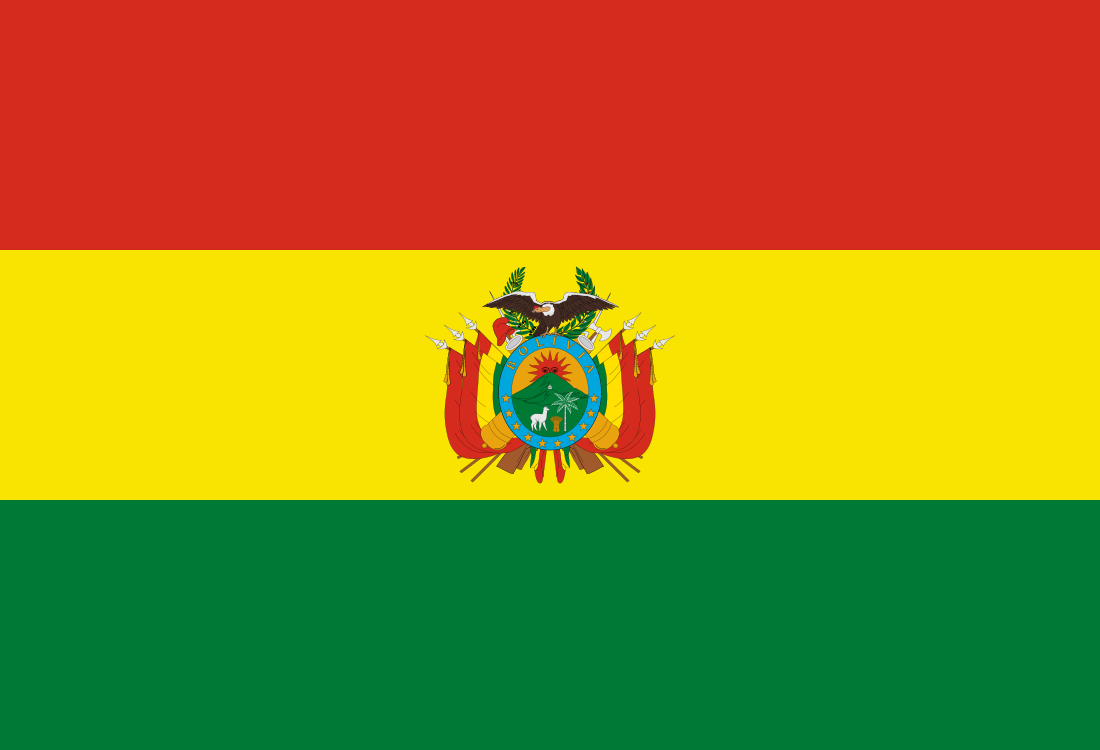
Adopted in 1851
| Capital | Sucre |
|---|---|
| Population | 12 413 315 inh. |
| Area | 1 098 580 km² |
| Population density | 11.3 inh./km² |
| Local time | --:-- |
| Language(s) | Spanish |
| Political system | Unitary presidential constitutional republic |
| National motto | La unión es la fuerza (Unity is Strength) |
| National anthem | Himno Nacional de Bolivia |
| Currency | Bolivian boliviano (BOB) |
| Land borders | Brazil, Paraguay, Argentina, Chile, Peru |
The flag: history and symbolism
Flag History
After independence was declared in 1825, Bolivia adopted several successive flags, including a first green and red flag. The current red, yellow and green flag was set on 31 October 1851 under President Manuel Isidoro Belzu.
The state flag, used by institutions, bears in its centre the coat of arms of Bolivia, with the Cerro Rico of Potosí, a condor and a rising sun. The civil flag has only the three stripes.
The 2009 Constitution recognises, alongside the tricolour, the wiphala, the multicoloured chequered flag of the Andean peoples, as a symbol of the state.
Meaning of Colours & Emblems
The colours of the Bolivian flag are generally interpreted as follows:
- Red: the blood shed by the heroes of independence and the courage of the army.
- Yellow: the country's mineral wealth, particularly silver and tin.
- Green: the fertility of the land and hope.
Anecdotes & Fun Facts
17 August is Flag Day in Bolivia, in memory of the adoption of the first national flag, shortly after independence.
The wiphala, made up of 49 squares in seven colours, now flies alongside the tricolour on many Bolivian public buildings.
The Bolivian flag resembles that of Ghana, which combines the same colours with a black star, and that of Lithuania, where yellow is at the top.
Similar Flags Around the World


Sport and history
National teams
Frequently asked questions
What is the capital of Bolivia?
Sucre is the capital of Bolivia.
What do the colours of the flag of Bolivia mean?
The colours of the Bolivian flag are generally interpreted as follows: Red: the blood shed by the heroes of independence and the courage of the army. Yellow: the country's mineral wealth, particularly silver and tin. Green: the fertility of the land and hope.