Adopted in 1996
| Capital | Addis Ababa |
|---|---|
| Population | 132 059 767 inh. |
| Area | 1 136 240 km² |
| Population density | 116.2 inh./km² |
| Local time | --:-- |
| Language(s) | None |
| Political system | Federal parliamentary republic |
| National anthem | March Forward, Dear Mother Ethiopia |
| Currency | Ethiopian birr (ETB) |
| Land borders | Eritrea, Somalia, Sudan, Kenya, Djibouti, South Sudan |
The flag: history and symbolism
Flag History
Green, yellow and red have been associated with Ethiopia since the end of the 19th century. Under Emperor Menelik II, who defeated Italy at the Battle of Adwa in 1896, these colours appeared on pennants, then formed a tricolour flag at the beginning of the 20th century.
Under the Empire, the flag bore in its centre the Lion of Judah, the symbol of the Solomonic dynasty. The lion disappeared after the fall of Emperor Haile Selassie in 1974, and various emblems followed under the military regime and then the People's Democratic Republic.
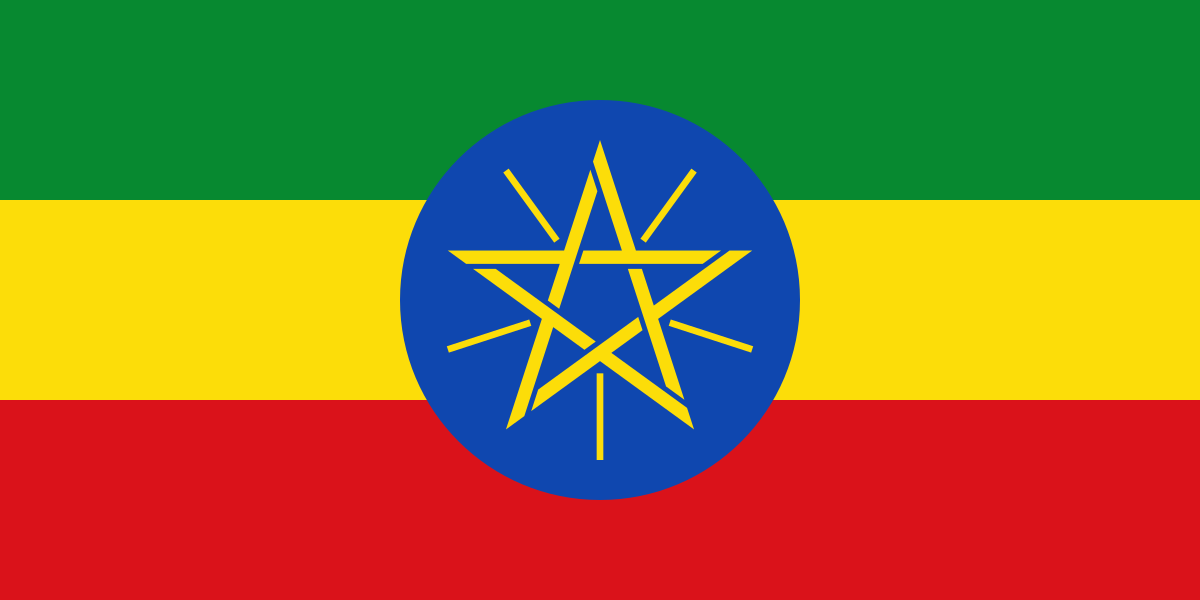
The current flag was adopted in 1996: it keeps the three bands and bears in its centre a blue disc with a yellow five-pointed star, from which rays emanate.
Meaning of Colours & Emblems
The elements of the Ethiopian flag are generally interpreted as follows:
- Green: the land, fertility and hope.
- Yellow: peace, harmony and religious freedom.
- Red: the sacrifice and heroism of those who defended the country.
- Star and blue disc: the unity and equality of the peoples and nations of Ethiopia; blue symbolises peace.
Anecdotes & Fun Facts
Ethiopia was never colonised, apart from the Italian occupation of 1936 to 1941. Its colours therefore became a symbol of independence for the whole of Africa: they are known as the pan-African colours.
The Rastafari movement, which emerged in Jamaica in the 1930s and reveres Haile Selassie, adopted the Ethiopian flag with the Lion of Judah as one of its emblems.
The Ethiopian flag resembles that of Bolivia, whose colours are arranged in reverse order: red, yellow and green.
Similar Flags Around the World


Sport and history
Frequently asked questions
What is the capital of Ethiopia?
Addis Ababa is the capital of Ethiopia.
What do the colours of the flag of Ethiopia mean?
The elements of the Ethiopian flag are generally interpreted as follows: Green: the land, fertility and hope. Yellow: peace, harmony and religious freedom. Red: the sacrifice and heroism of those who defended the country. Star and blue disc: the unity and equality of the peoples and nations of Ethiopia; blue symbolises peace.