Adopted in 1963
| Capital | Nairobi |
|---|---|
| Population | 56 432 944 inh. |
| Area | 580 370 km² |
| Population density | 97.2 inh./km² |
| Local time | --:-- |
| Language(s) | Swahili, English |
| Political system | Unitary presidential constitutional republic |
| National motto | Harambee (Let us all pull together) |
| National anthem | Ee Mungu Nguvu Yetu (O God of all creation) |
| Currency | Kenyan shilling (KES) |
| Land borders | South Sudan, Ethiopia, Somalia, Uganda, Tanzania |
| Maritime borders | Indian Ocean |
The flag: history and symbolism
Flag History
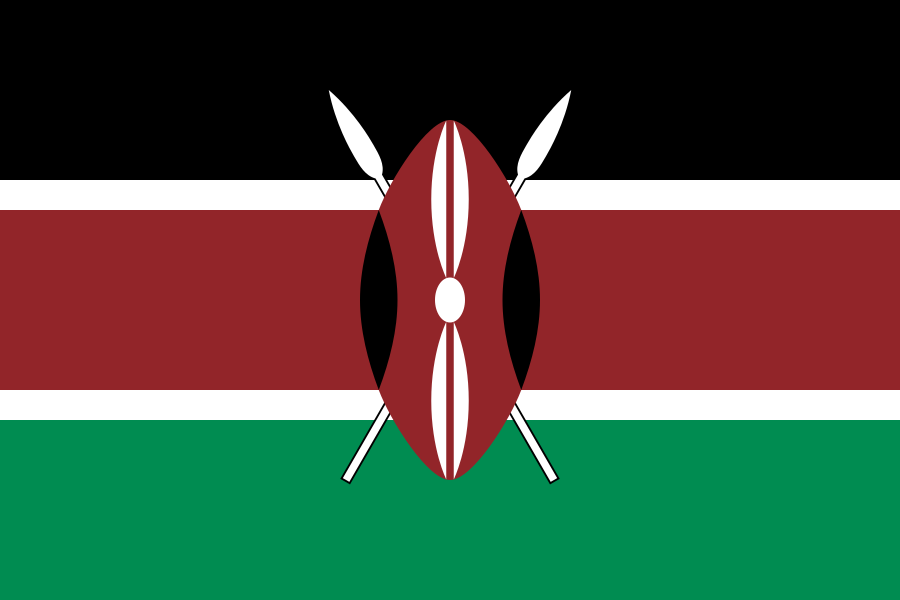
The flag of Kenya is based on that of the Kenya African National Union (KANU), the leading party of the independence movement, which was black, red and green. Two narrow white bands were added, together with a Maasai shield and two crossed spears.
It was raised for the first time on 12 December 1963, the day Kenya, a former British colony, became independent. That date has become the national holiday, Jamhuri Day (‘Republic Day’).
The flag has not changed since independence. The 2010 Constitution lists it among the national symbols and describes its colours.
Meaning of Colours & Emblems
Each element of the Kenyan flag has a precise meaning:
- Black: the people of Kenya.
- Red: the blood shed during the struggle for independence.
- Green: the land and the country's natural wealth.
- White: peace and unity.
- Shield and spears: the defence of freedom and of everything listed above.
Anecdotes & Fun Facts
On independence day, 12 December 1963, a team of climbers led by the Kenyan Kisoi Munyao planted the new flag at the top of Mount Kenya, the country's highest mountain, which gave the nation its name.
The shield on the flag is inspired by the traditional shields of the Maasai, a pastoralist people of southern Kenya and northern Tanzania.
Kenyan distance runners, Olympic champions and winners of the major marathons, have made this flag one of the most familiar sights on athletics podiums.
Similar Flags Around the World

Sport and history
National teams
Athletes
- Beatrice Chebet
- David Rudisha
- Ezekiel Kemboi
- Faith Kipyegon
- Amos Kipruto
- Benson Kipruto
- Brigid Kosgei
- Catherine Ndereba
- Cosmas Ndeti
- Dennis Kimetto
- Dickson Chumba
- Douglas Wakiihuri
- Edna Kiplagat
- Elijah Lagat
- Eliud Kipchoge
- Evans Chebet
- Evans Rutto
- Felix Limo
- Florence Kiplagat
- Geoffrey Mutai
- Gladys Cherono
- Helah Kiprop
- Hellen Obiri
- Ibrahim Hussein
- John Korir
- Joseph Chebet
- Joyce Chepchumba
- Joyciline Jepkosgei
- Kelvin Kiptum
- Lawrence Cherono
- Margaret Okayo
- Martin Lel
- Mary Jepkosgei Keitany
- Paul Tergat
- Peres Jepchirchir
- Priscah Jeptoo
- Rita Jeptoo
- Robert K. Cheruiyot
- Rodgers Rop
- Rosemary Wanjiru
- Ruth Chepngetich
- Sabastian Sawe
- Salim Kipsang
- Salina Kosgei
- Samuel Wanjiru
- Sharon Lokedi
- Simon Biwott
- Stanley Biwott
- Tegla Loroupe
- Wilson Kipsang
- Wilson Kipsang Kiprotich
Olympic Games
Frequently asked questions
What is the capital of Kenya?
Nairobi is the capital of Kenya.
What do the colours of the flag of Kenya mean?
Each element of the Kenyan flag has a precise meaning: Black: the people of Kenya. Red: the blood shed during the struggle for independence. Green: the land and the country's natural wealth. White: peace and unity. Shield and spears: the defence of freedom and of everything listed above.
Which countries border Kenya?
Kenya shares land borders with: South Sudan, Ethiopia, Somalia, Uganda, Tanzania.