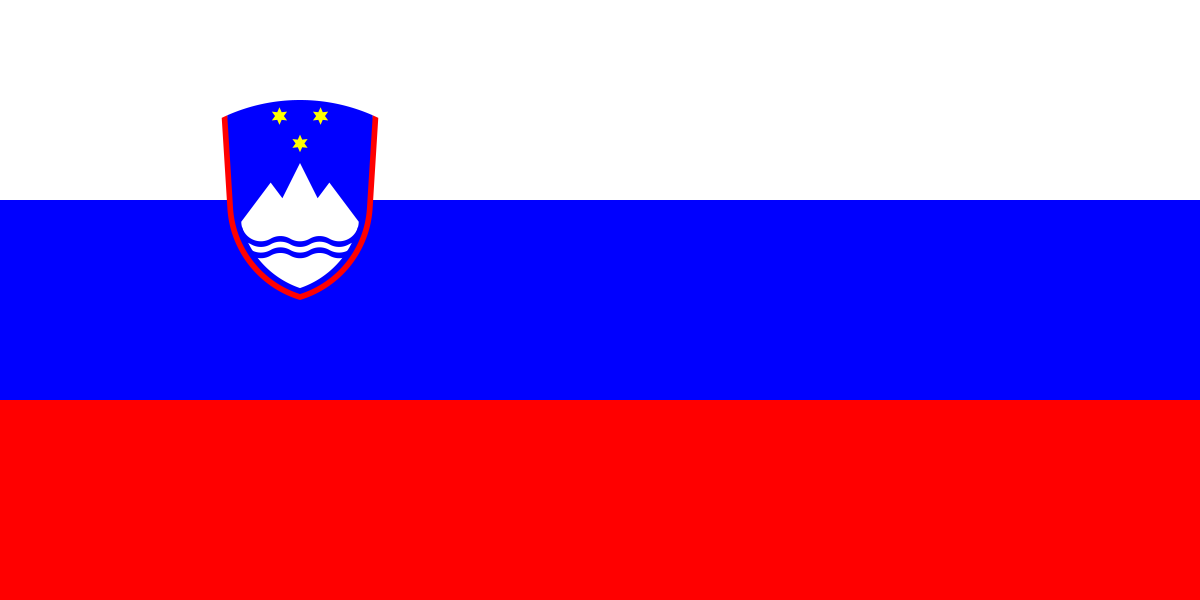
Adopted in 1991
| Capital | Ljubljana |
|---|---|
| Population | 2 126 324 inh. |
| Area | 20 480 km² |
| Population density | 103.8 inh./km² |
| Local time | --:-- |
| Language(s) | Slovene |
| Political system | Parliamentary republic |
| National anthem | Zdravljica (A Toast) |
| Currency | Euro (EUR) |
| Land borders | Italy, Austria, Hungary, Croatia |
| Maritime borders | Adriatic Sea |
The flag: history and symbolism
Flag History
White, blue and red are the colours of the arms of the former Duchy of Carniola, the historic heart of Slovenia: a blue eagle bearing a red and white chequered crescent, on a white field.
The Slovenian tricolour was first raised on 7 April 1848 in Ljubljana by the poet Lovro Toman, during the Springtime of Nations. During the Yugoslav period, the Socialist Republic of Slovenia used it with a red star.
The current flag was adopted in June 1991, when Slovenia became independent. It bears in the upper corner at the hoist the country's new coat of arms, designed by the sculptor Marko Pogačnik.
Meaning of Colours & Emblems
The elements of the Slovenian flag are generally interpreted as follows:
- White, blue and red: the colours of Carniola, which are also the pan-Slavic colours.
- Triglav: the country's highest peak, shown in white, is the symbol of the Slovenian nation.
- Wavy lines: the Adriatic Sea and the country's rivers.
- Three stars: they come from the arms of the Counts of Celje, a great medieval family of the Slovenian lands.
Anecdotes & Fun Facts
Triglav, which appears on the flag, is also shown on the Slovenian 50 euro cent coin. According to tradition, every Slovenian should climb it at least once in their life.
The Slovenian flag is often confused with those of Slovakia and Russia, which have the same colours in the same order.
25 June, the day independence was declared in 1991, is Slovenia's national day.
Similar Flags Around the World


Sport and history
National teams
Olympic Games
Frequently asked questions
What is the capital of Slovenia?
Ljubljana is the capital of Slovenia.
What do the colours of the flag of Slovenia mean?
The elements of the Slovenian flag are generally interpreted as follows: White, blue and red: the colours of Carniola, which are also the pan-Slavic colours. Triglav: the country's highest peak, shown in white, is the symbol of the Slovenian nation. Wavy lines: the Adriatic Sea and the country's rivers. Three stars: they come from the arms of the Counts of Celje, a great medieval family of the Slovenian lands.