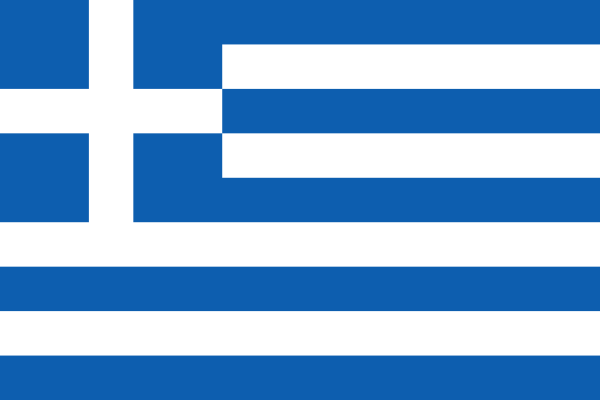
Adopted in 1978
| Capital | Athens |
|---|---|
| Population | 10 388 805 inh. |
| Area | 131 960 km² |
| Population density | 78.7 inh./km² |
| Local time | --:-- |
| Language(s) | Greek |
| Political system | Unitary parliamentary constitutional republic |
| National motto | Freedom or Death |
| National anthem | Hymn to Liberty |
| Currency | Euro (EUR) |
| History | View timeline |
| Land borders | Albania, Macédoine, Bulgaria, Turkey |
| Maritime borders | Ionian Sea, Aegean Sea |
The flag: history and symbolism
Flag History
The Greek flag was born during the War of Independence against the Ottoman Empire, which broke out in 1821. In January 1822, the First National Assembly, meeting at Epidaurus, made blue and white the colours of Greece, and a decree of March 1822 established two flags: a white cross on a blue field for use on land, and a flag of blue and white stripes, with a cross in the canton, for use at sea.
For almost a century and a half, the two flags coexisted: the cross flag was the national flag used on land, while the striped flag served as the ensign of the navy and the merchant fleet.
The law of 22 December 1978 made the nine-striped flag the sole national flag, on land and at sea. As the shade of blue is not precisely defined by law, it varies between manufacturers, from light to dark blue.
Meaning of Colours & Emblems
No official text gives a precise meaning to the elements of the Greek flag, but several interpretations are widely held:
- White cross: the Orthodox Christian faith, which played a central role in Greek identity under Ottoman rule.
- Nine stripes: they are said to correspond to the nine syllables of the insurgents' motto, ‘Ελευθερία ή Θάνατος’ (‘Freedom or Death’).
- Blue and white: they are often associated with the sky and the sea, or with the white waves of the Aegean.
Other, less common readings link the nine stripes to the nine Muses of Greek mythology.
Anecdotes & Fun Facts
On the night of 30 to 31 May 1941, during the German occupation, two young students, Manolis Glezos and Apostolos Santas, climbed the Acropolis and tore down the swastika flag flying there. The act made them symbols of the Greek Resistance.
At the closing ceremony of the Olympic Games, the Greek flag is raised alongside those of the host country and of the next host country, in tribute to ancient Greece, the birthplace of the Games. At the opening ceremony, the Greek team always leads the athletes' parade.
The choice between the two flags long carried political weight. The Colonels' dictatorship (1967-1974) made the striped flag the sole national flag; after the return of democracy, the cross flag was restored in 1975, before the law of 22 December 1978 definitively established the striped flag.
Similar Flags Around the World

Sport and history
National teams
Athletes
Clubs
Competitions
Olympic Games
History
Historical figures
Frequently asked questions
What is the capital of Greece?
Athens is the capital of Greece.
What do the colours of the flag of Greece mean?
No official text gives a precise meaning to the elements of the Greek flag, but several interpretations are widely held: White cross: the Orthodox Christian faith, which played a central role in Greek identity under Ottoman rule. Nine stripes: they are said to correspond to the nine syllables of the insurgents' motto, ‘Ελευθερία ή Θάνατος’ (‘Freedom or Death’). Blue and white: they are often associated with the sky and the sea, or with the white waves of the Aegean. Other, less common readings link the nine stripes to the nine Muses of Greek mythology.