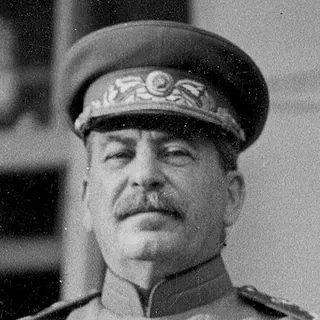
Joseph Stalin
Key Facts
- Born Ioseb Jughashvili on 18 December 1878 in Gori, Georgia, the son of a shoemaker
- General Secretary of the Communist Party from 3 April 1922
- Launched the first five-year plan in 1928, followed by the forced collectivisation of farmland
- Ordered the Great Terror (1936-1938), in which some 700,000 people were executed
- Signed the Nazi-Soviet Pact with Hitler on 23 August 1939
- Led the USSR through the Second World War, from the German invasion to the capture of Berlin
- Died on 5 March 1953; Khrushchev denounced his crimes in 1956
Biography
Joseph Stalin (1878-1953) ruled the Soviet Union for almost thirty years, from Lenin's death in 1924 until his own death in 1953. The architect of breakneck industrialisation and the victor over Nazi Germany, he was also responsible for one of the deadliest waves of repression of the twentieth century: famines, deportations, the Gulag camps and mass executions.
Born Ioseb Besarionis dze Jughashvili on 18 December 1878 in Gori, Georgia, then a province of the Russian Empire, he was the son of a shoemaker. A pupil at the Orthodox seminary in Tiflis, which he left in 1899, he turned to clandestine revolutionary work alongside Lenin's Bolsheviks: strikes, propaganda and the armed robbery of a cash convoy in Tiflis in 1907. Arrested and exiled to Siberia several times, from 1913 he signed his writings with the pseudonym Stalin, from the Russian word for steel. People's Commissar for Nationalities after the October Revolution, he became General Secretary of the Communist Party on 3 April 1922, a post that gave him control of the party machine.
Despite Lenin's warning, whose “testament” recommended removing him, he eliminated his rivals one by one after 1924: Trotsky was expelled from the party in 1927, banished from the USSR in 1929 and assassinated in Mexico in 1940. From 1928 onwards, the five-year plans industrialised the country at a frantic pace, while the collectivisation of farmland, imposed by force, caused a famine in 1932-1933 that killed several million people, above all in Ukraine and Kazakhstan. During the Great Terror of 1936-1938, some 700,000 people were executed and hundreds of thousands more were sent to the Gulag, while the cult of his personality pervaded public life.
On 23 August 1939 he concluded the Nazi-Soviet Pact with Hitler, which allowed him to annex eastern Poland and the Baltic states. Caught off guard by the German invasion of 22 June 1941, he went on to direct the war from the Kremlin; the victory at Stalingrad in February 1943 marked the turning point of the conflict, and the Red Army took Berlin in May 1945. At the Tehran, Yalta and Potsdam conferences he secured a sphere of influence over Eastern Europe, which communist regimes would dominate for more than forty years. The war cost the USSR some 27 million lives; in 1949 the country acquired the atomic bomb, at the start of the Cold War.
Stalin died on 5 March 1953 at his dacha in Kuntsevo, near Moscow, aged seventy-four. In February 1956 Nikita Khrushchev denounced his crimes and the cult of personality before the Twentieth Party Congress; his embalmed body, displayed next to Lenin's in the mausoleum on Red Square, was removed in 1961. Still admired by some Russians as the man who won the war, he remains for historians responsible for the deaths of millions.