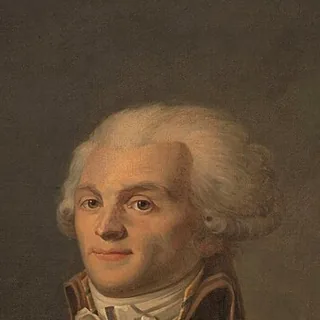
Maximilien Robespierre
Key Facts
- Born on 6 May 1758 in Arras; a former scholarship pupil at the Collège Louis-le-Grand, he becomes a lawyer
- Elected deputy of the Third Estate of Artois to the Estates-General in 1789
- Nicknamed “the Incorruptible”, a leading figure of the Jacobin Club
- Calls before the Convention for the death of Louis XVI, executed in January 1793
- Joins the Committee of Public Safety in July 1793
- Organises the Festival of the Supreme Being on 8 June 1794
- Arrested on 9 Thermidor Year II (27 July 1794) and guillotined the next day
Biography
Maximilien Robespierre (1758-1794) is one of the most striking and controversial figures of the French Revolution. An uncompromising champion of popular sovereignty and equality, nicknamed “the Incorruptible”, he became in 1793-1794 the dominant figure of the Committee of Public Safety, at the heart of the Terror.
Born on 6 May 1758 in Arras, he lost his mother at six, and his father abandoned the family. A scholarship pupil at the Collège Louis-le-Grand in Paris, he became a lawyer in Arras, where he was noted for his pleadings and his admiration for Rousseau. Elected in 1789 as deputy of the Third Estate of Artois to the Estates-General, he made his mark in the Constituent Assembly as one of its most radical speakers: he defended universal suffrage, opposed the interests of the slave-owning colonists and in 1791 called for the abolition of the death penalty.
A leading figure of the Jacobin Club, he opposed the war sought by the Girondins in 1792. Elected to the Convention after the fall of the monarchy, he demanded the death of Louis XVI, who was executed in January 1793. After the Girondins were purged in June 1793, he joined the Committee of Public Safety in July. Faced with foreign war, the war in the Vendée and the federalist revolts, the Committee governed through emergency measures: the Law of Suspects, the Revolutionary Tribunal and price and wage controls.
In the spring of 1794, Robespierre had his rivals eliminated: the Hébertists in March, then Danton and his friends, guillotined in April. On 8 June he presided over the Festival of the Supreme Being, while the Law of 22 Prairial sped up trials before the Revolutionary Tribunal: this was the “Great Terror”. Fearing for their lives, many deputies united against him. On 9 Thermidor Year II (27 July 1794) he was indicted in the Convention and arrested; he was guillotined the next day on the Place de la Révolution, together with Saint-Just, Couthon and some twenty of his supporters.
His fall opened the Thermidorian Reaction and ended the Terror. Robespierre remains a deeply contested figure: to some, an idealist devoted to human rights and democracy; to others, the symbol of revolutionary dictatorship and state violence. No street in Paris bears his name, a sign of the divided memory he left behind.