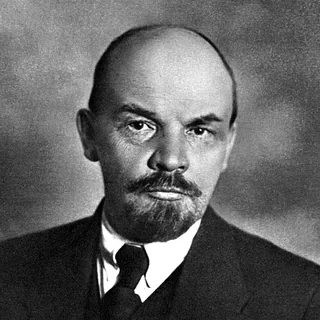
Vladimir Lenin
Key Facts
- Born Vladimir Ilyich Ulyanov on 22 April 1870 in Simbirsk, on the Volga
- Marked by the hanging of his elder brother Alexander in 1887 for plotting against the tsar
- Founds in 1903 the Bolshevik faction of the Russian Social Democratic Labour Party
- Returns from exile in April 1917 and publishes his April Theses
- Leads the Bolshevik seizure of power in Petrograd on 7 November 1917 (25 October in the Julian calendar)
- Launches the New Economic Policy (NEP) in March 1921
- Dies on 21 January 1924 at Gorki, near Moscow; his embalmed body lies in Red Square
Biography
Lenin (1870-1924), born Vladimir Ilyich Ulyanov, was the founder of the Bolshevik party and the chief architect of the October Revolution of 1917. As the first leader of Soviet Russia, he established a one-party regime that profoundly shaped the 20th century.
Born on 22 April 1870 in Simbirsk, on the Volga, into an educated family (his father was a school inspector), he was marked by the execution of his elder brother Alexander, hanged in 1887 for taking part in a plot against Tsar Alexander III. Expelled from Kazan University for political agitation, he later obtained a law degree and turned to Marxism. Arrested in 1895 in Saint Petersburg, he was exiled to Siberia, then left for Western Europe in 1900. In What Is to Be Done? (1902) he argued for a party of professional revolutionaries; in 1903 the split of the Russian Social Democratic Labour Party gave birth to his faction, the Bolsheviks.
After the failure of the 1905 revolution, Lenin spent most of his time in exile, notably in Switzerland, from where he denounced the First World War as an imperialist war. After the fall of the tsar in March 1917, Germany let him cross its territory to return to Russia. Arriving in Petrograd in April, he published his April Theses, which demanded the transfer of all power to the soviets. On 25 October (7 November in the Gregorian calendar), the Bolsheviks overthrew the provisional government; Lenin became head of the Council of People's Commissars and had the decrees on peace and on land adopted.
To get out of the war, he imposed the Peace of Brest-Litovsk in March 1918, at the cost of huge territorial losses. He dissolved the Constituent Assembly, in which the Bolsheviks were in a minority, and relied on the Cheka, the political police, to wage the “Red Terror” against his opponents. Victorious in the civil war, he nevertheless had to retreat in the face of the country's ruin: in March 1921, at the time of the Kronstadt rebellion, he had the New Economic Policy (NEP) adopted, restoring a measure of market economy. He founded the USSR in December 1922 but, weakened by an assassination attempt in 1918 and then by several strokes from 1922, he died on 21 January 1924 at Gorki, near Moscow.
His embalmed body is displayed in a mausoleum in Red Square, and Petrograd was called Leningrad from 1924 to 1991. Leninism, combined with Marxism, became the official doctrine of the USSR and of many communist regimes. His legacy remains hotly debated: a hero of the revolution for his supporters, he was also the founder of a police state whose repression his successor, Stalin, made even harsher.