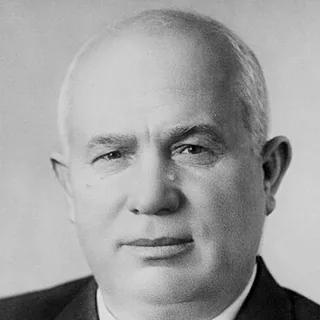
Nikita Khrushchev
Key Facts
- Born on 15 April 1894 in Kalinovka, in the Kursk region, into a peasant family
- First Secretary of the Communist Party of the Soviet Union from 1953 to 1964
- Denounced Stalin's crimes in his “Secret Speech” of 25 February 1956
- Had the Hungarian uprising crushed in November 1956
- Presided over the Soviet space triumphs: Sputnik (1957), then Yuri Gagarin (1961)
- Faced John F. Kennedy during the Cuban Missile Crisis in October 1962
- Ousted on 14 October 1964, he died in Moscow on 11 September 1971
Biography
Nikita Khrushchev (1894-1971) led the Soviet Union from 1953 to 1964. Stalin's successor, he denounced his predecessor's crimes, opened a period of relative relaxation at home and launched the USSR into the space race, but he also brought the world to the brink of nuclear war during the Cuban Missile Crisis.
Born on 15 April 1894 in Kalinovka, a village in the Kursk region near Ukraine, into a poor peasant family, he worked from an early age as a metal fitter and then in the mines of the Donbas. He joined the Bolsheviks in 1918 and served as a political commissar in the Red Army during the Civil War. Noticed by the party apparatus, he rose through the ranks under Stalin: head of the party in Moscow in the mid-1930s, he oversaw the building of the Metro, then from 1938 led the Communist Party of Ukraine at the height of the Great Terror, in which he took part. A member of the Politburo from 1939, he served as a political commissar during the Second World War, notably at Stalingrad.
When Stalin died in March 1953, he joined forces with the other leaders to have Lavrentiy Beria, the head of the secret police, arrested, and in September he became First Secretary of the party. On 25 February 1956, before the Twentieth Congress, he delivered a “Secret Speech” denouncing the cult of personality and Stalin's crimes; many Gulag prisoners were released and rehabilitated. This de-Stalinisation had its limits: in November 1956 the Red Army crushed the Hungarian uprising. Having defeated his opponents of the “Anti-Party Group” in 1957, from 1958 he led both the party and the government. The launch of Sputnik in 1957, followed by Yuri Gagarin's flight in 1961, made the USSR the pioneer of space.
His foreign policy alternated between détente and shows of force. The first Soviet leader to visit the United States, in 1959, he advocated “peaceful coexistence”, yet he allowed the Berlin Wall to be built in August 1961 and secretly deployed nuclear missiles in Cuba. The October 1962 crisis ended with their withdrawal, in exchange for an American pledge not to invade the island and, secretly, the removal of American missiles from Turkey. Agricultural failures, despite the Virgin Lands campaign in Kazakhstan, the split with China and his unpredictable style alienated the party leadership: on 14 October 1964 he was removed from office and replaced by Leonid Brezhnev.
Pensioned off and kept under watch, Khrushchev dictated his memoirs, published in the West in 1970. He died in Moscow on 11 September 1971, aged seventy-seven, and was buried in Novodevichy Cemetery rather than by the Kremlin wall. His tombstone, the work of the sculptor Ernst Neizvestny, combines white and black blocks, an image of a mixed legacy: that of a man who ended mass terror without giving up the system that had produced it.