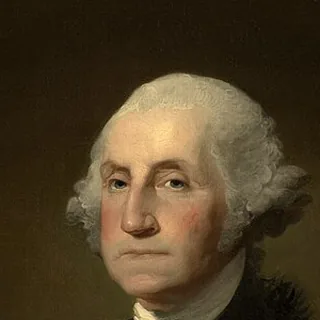
George Washington
Key Facts
- Born on 22 February 1732 in Virginia, into a family of planters
- Officer in the Virginia militia during the French and Indian War (1754-1763)
- Appointed commander-in-chief of the Continental Army by Congress in June 1775
- Secures, with Rochambeau, the British surrender at Yorktown on 19 October 1781
- Presides over the Philadelphia Convention, which drafts the Constitution, in 1787
- First President of the United States (1789-1797), he declines a third term
- Dies on 14 December 1799; his will provides for the freeing of the 123 people he enslaved
Biography
George Washington (1732-1799) was the commander-in-chief of the army that won the independence of the United States, then the country's first president. Known as the “Father of His Country”, he embodies the birth of the American republic and the idea of a peaceful transfer of power.
Born on 22 February 1732 into a family of Virginia planters, Washington received a limited education and became a surveyor in his teens. As an officer in the Virginia militia, he fought the French and their Native American allies at the start of the French and Indian War: the skirmish at Jumonville Glen, in 1754, helped trigger the conflict. In 1759 he married Martha Dandridge Custis, a wealthy widow, and became one of Virginia's leading planters, running the Mount Vernon estate through the labour of many enslaved people. Elected to the colony's assembly, he opposed the taxes imposed by London.
A Virginia delegate to the Continental Congress, he was appointed commander-in-chief of the Continental Army in June 1775. Facing a better-equipped British army, he lost New York in 1776, but revived the struggle by crossing the Delaware to win at Trenton on 26 December. He held his troops together through the harsh winter at Valley Forge (1777-1778), while the French alliance, concluded after Saratoga, shifted the balance of power. With the Comte de Rochambeau and Admiral de Grasse's fleet, he forced General Cornwallis to surrender at Yorktown on 19 October 1781. In December 1783 he resigned his commission to Congress and returned to Mount Vernon, a gesture that struck his contemporaries.
Worried by the weakness of the government created by the Articles of Confederation, he presided in 1787 over the Philadelphia Convention, which drafted the federal Constitution. Elected unanimously by the Electoral College, he became the first President of the United States on 30 April 1789 and was re-elected in 1792. He set up the federal institutions, backed Alexander Hamilton's financial policy and kept the country neutral in the war between revolutionary France and Great Britain. In 1796 he declined a third term and published his Farewell Address, which warned against partisan spirit and permanent alliances.
Washington died at Mount Vernon on 14 December 1799. His will provided for the freeing of the 123 people he enslaved, a rare decision among the nation's founders; his widow freed them on 1 January 1801. The federal capital and a state bear his name, and the two-term limit he set himself became a constitutional rule in 1951.