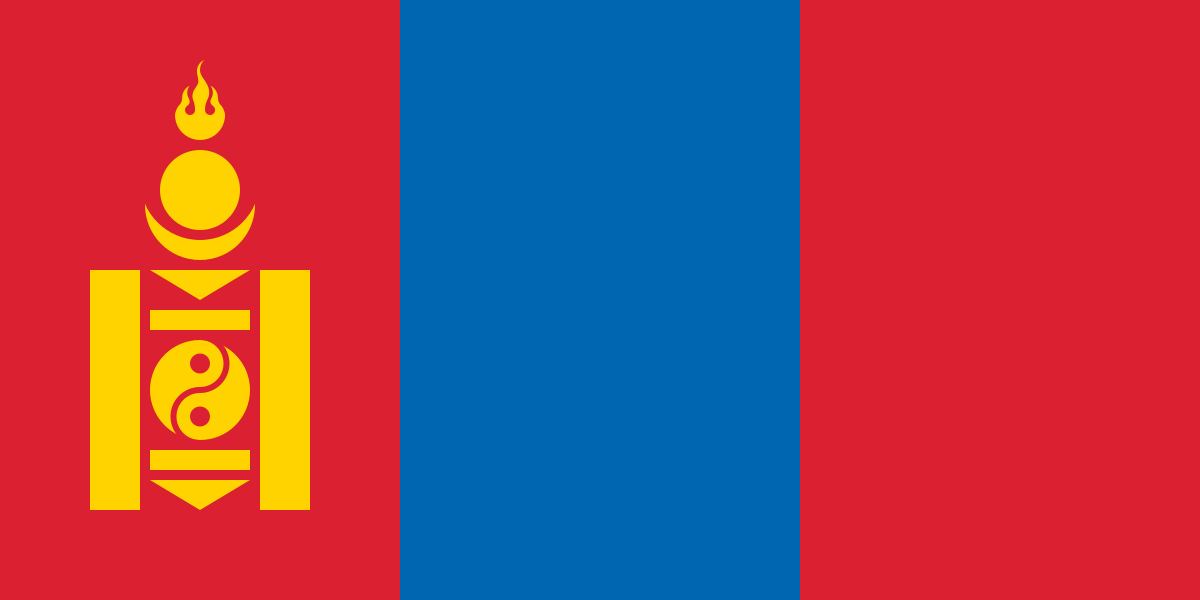
Adopted in 1992
| Capital | Ulaanbaatar |
|---|---|
| Population | 3 524 788 inh. |
| Area | 1 564 120 km² |
| Population density | 2.3 inh./km² |
| Local time | --:-- |
| Language(s) | Mongolian |
| Political system | Unitary semi-presidential republic |
| National anthem | Mongol Ulsyn töriin duulal |
| Currency | Mongolian tögrög (MNT) |
| Land borders | Russia, China |
The flag: history and symbolism
Flag History
The Mongolian flag bears the soyombo, a symbol created in 1686 by the monk and scholar Zanabazar, the spiritual leader of Mongolian Buddhism. It became a national emblem when Mongolia declared independence in 1911.
During the People's Republic, a communist star topped the soyombo. It disappeared on 12 January 1992, with the adoption of the current flag after the end of communist rule.
The flag consists of three vertical stripes, red, blue and red, with the golden soyombo on the red stripe at the hoist.
Meaning of Colours & Emblems
The elements of the Mongolian flag have a traditional meaning:
- Blue: the eternal sky, the central deity of ancient Mongolian beliefs.
- Red: progress and prosperity, or fire.
- Soyombo: it combines fire (prosperity), the sun and the moon (the origin of the Mongolian people), triangles and rectangles (the defence of freedom and honesty), and two fish (vigilance).
Anecdotes & Fun Facts
The soyombo takes its name from a script devised by Zanabazar to write Mongolian, of which it is one of the characters.
The two fish in the soyombo form a pattern close to the yin and yang symbol and stand for vigilance, as fish never close their eyes.
The Mongolian flag is often flown on the steppe outside yurts during Naadam, the great national festival in July devoted to wrestling, archery and horse racing.
Flags of Neighbouring Countries


Sport and history
Frequently asked questions
What is the capital of Mongolia?
Ulaanbaatar is the capital of Mongolia.
What do the colours of the flag of Mongolia mean?
The elements of the Mongolian flag have a traditional meaning: Blue: the eternal sky, the central deity of ancient Mongolian beliefs. Red: progress and prosperity, or fire. Soyombo: it combines fire (prosperity), the sun and the moon (the origin of the Mongolian people), triangles and rectangles (the defence of freedom and honesty), and two fish (vigilance).