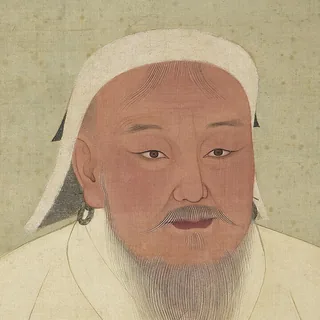
Genghis Khan
Key Facts
- Born Temüjin around 1162 near the Onon River, in present-day Mongolia
- Unified the tribes of the steppe and was proclaimed Genghis Khan by the kurultai of 1206
- Organised the army into units of ten, a hundred and a thousand men
- Took Zhongdu (Beijing), the Jin capital, in 1215
- Invaded the Khwarazmian Empire in 1219 and seized Bukhara and Samarkand in 1220
- Died in August 1227 during his campaign against the Western Xia; his tomb has never been found
Biography
Genghis Khan (c. 1162-1227) was the founder of the Mongol Empire. A clan chief who became master of all the tribes of the steppe, he sent his horsemen to conquer northern China and Central Asia and laid the foundations of the largest contiguous empire in history, which his successors would extend from Korea to Eastern Europe. Admired for his military and political genius, he is also associated with massacres on an unprecedented scale.
Born Temüjin near the Onon River, in present-day Mongolia, on an uncertain date (1162 is the year most often given), he was the son of Yesügei, a chief of the Borjigin clan. His father was poisoned by Tatars when he was still a child, and his family, abandoned by their clan, lived in poverty. Allied with more powerful chiefs, among them Toghrul, khan of the Keraites, he gradually subdued the rival tribes: the Tatars, the Keraites and the Naimans. In 1206 a great assembly of Mongol chiefs, the kurultai, meeting near the source of the Onon, proclaimed him Genghis Khan.
He reorganised Mongol society around the army, divided into units of ten, a hundred and a thousand men, whose command he entrusted to loyal followers chosen for their merit rather than their birth. He had the Uyghur alphabet adopted to write the Mongolian language and set up a common system of justice. His campaigns were directed first at the kingdom of the Western Xia, which submitted in 1210, then at the Jin empire in northern China, whose capital, Zhongdu (present-day Beijing), fell in 1215. In 1219, after Khwarazm had massacred a caravan and executed his envoys, he invaded that Central Asian empire: Bukhara and Samarkand were taken in 1220, and entire cities were razed.
Back in Mongolia, he went to war again against the Western Xia, who had refused to join his campaign in the west. Weakened, according to the sources, by a fall from his horse, he died in August 1227 during this campaign, shortly before the fall of the Xia capital. His burial place, kept secret, has never been found. His third son, Ögedei, succeeded him in 1229 after a two-year regency.
His sons and grandsons pursued the conquests: the Russian principalities, Iran and the whole of China came under their rule, and his grandson Kublai founded the Yuan dynasty in 1271. Long portrayed in the West and in the conquered lands as a destroyer, Genghis Khan is a national hero in Mongolia: Ulaanbaatar's international airport bears his name and his portrait appears on the country's banknotes.