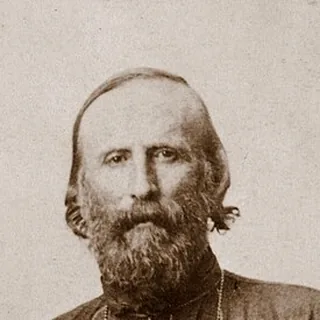
Giuseppe Garibaldi
Key Facts
- Born on 4 July 1807 in Nice, then French, into a family of sailors
- Sentenced to death in absentia in 1834 after a failed uprising in Piedmont
- Fights for some twelve years in South America, in Brazil and then Uruguay
- Defends the Roman Republic against the French army in 1849
- Conquers Sicily and Naples with the Expedition of the Thousand in 1860
- Hands the Kingdom of the Two Sicilies over to Victor Emmanuel II at Teano on 26 October 1860
- Dies on the island of Caprera on 2 June 1882
Biography
Giuseppe Garibaldi (1807-1882) is the most famous hero of the Risorgimento, the movement that unified Italy. A fighter for freedom on two continents, known as the “Hero of the Two Worlds”, he conquered the Kingdom of the Two Sicilies with about a thousand volunteers before handing it over to King Victor Emmanuel II.
Born on 4 July 1807 in Nice, then French, into a family of sailors, he went to sea in his teens. Won over to the ideas of Giuseppe Mazzini and Young Italy, he took part in 1834 in an attempted uprising in Piedmont; sentenced to death in absentia, he went into exile in South America. He fought there for some twelve years, first for the breakaway republic of Rio Grande do Sul, in Brazil, then for Uruguay against Rosas's Argentina, at the head of an Italian legion dressed in red shirts. There he met Anita, who became his comrade in arms and his wife.
Back in Italy in 1848, he fought the Austrians, then in 1849 defended the Roman Republic against the French army sent to restore the pope. After the fall of Rome, he fled across central Italy, pursued by several armies; Anita died during the retreat. After another exile, he rallied to the House of Savoy and in 1859 commanded the Hunters of the Alps against Austria. In May 1860 he landed at Marsala with about a thousand volunteers, the “Thousand”, conquered Sicily and entered Naples in September. On 26 October, at Teano, he handed his conquests over to Victor Emmanuel II, paving the way for the proclamation of the Kingdom of Italy in 1861.
Garibaldi remained obsessed with Rome, which the new state did not dare take from the pope, who was protected by France. In 1862 he was wounded and arrested by the Italian army at Aspromonte; he fought Austria again in 1866, then his march on Rome was halted at Mentana, in 1867, by papal and French troops. In 1870-1871 he fought for the young French Republic against Prussia at the head of the Army of the Vosges, and was elected to the National Assembly, from which he resigned at once. Retired to the island of Caprera, north of Sardinia, he died there on 2 June 1882.
A popular and selfless figure who turned down honours and wealth after 1860, Garibaldi became one of the symbols of unified Italy and of the struggle for the freedom of peoples. Almost every Italian town has a street or square named after him, and his memory remains alive in South America, particularly in Brazil and Uruguay.