| Capital | Paris |
|---|---|
| Population | 68 516 699 inh. |
| Area | 549 087 km² |
| Population density | 124.8 inh./km² |
| Local time | --:-- |
| Language(s) | French |
| Political system | Unitary semi-presidential republic |
| National motto | Liberté, Égalité, Fraternité (Liberty, Equality, Fraternity) |
| National anthem | La Marseillaise |
| Currency | Euro (EUR) |
| History | View timeline |
| Land borders | Belgium, Luxembourg, Germany, Switzerland, Italy, Monaco, Spain, Andorra |
| Maritime borders | North Sea, English Channel, Atlantic Ocean, Mediterranean Sea, Tyrrhenian Sea |
The flag: history and symbolism
Flag History
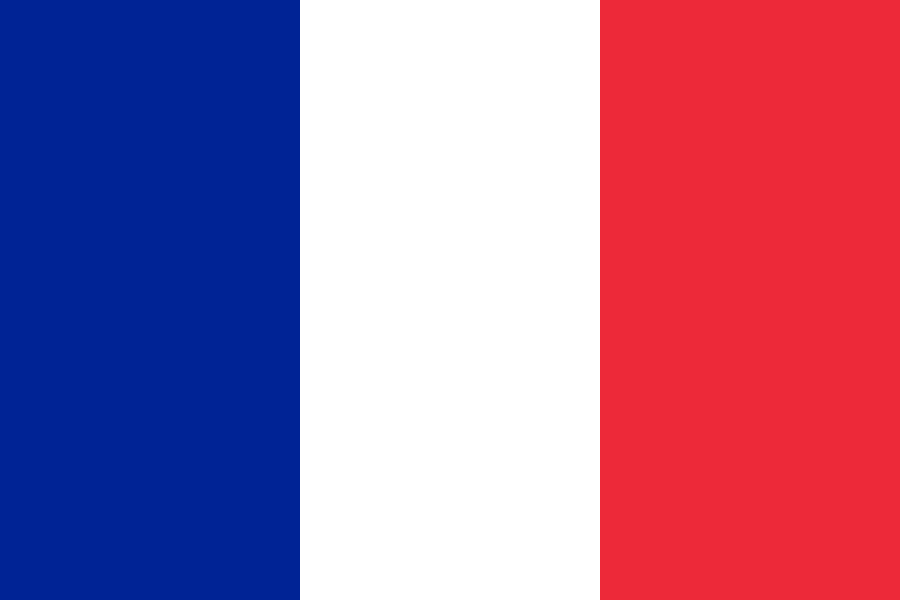
The tricolor flag has its roots in the revolutionary days of 1789. After the storming of the Bastille, Lafayette combined blue and red, the colors of the Paris cockade, with white, the traditional color of the monarchy, to symbolize reconciliation between the king and the people of Paris.
In its earliest versions, the flag placed red at the hoist and blue at the fly. The law of 27 Pluviôse Year II (15 February 1794) fixed the definitive order, blue, white, red, with blue at the hoist, on a proposal by the painter Jacques-Louis David.
Abolished under the Restoration in favor of the white Bourbon flag, the tricolor became the national emblem again after the July Revolution of 1830. The Third Republic made it the official flag of the nation, and the Constitution of 1958 confirms in Article 2 that "the national emblem is the blue, white and red tricolor flag."
Meaning of Colors & Emblems
Contrary to popular belief, no official text formally links each color to a specific value of the republican motto. The most widespread interpretation is nonetheless the following:
- Blue and red: the historic colors of the city of Paris, worn by the National Guard from 1789.
- White: the traditional color of the French monarchy, placed between the blue and the red to symbolize the union between the king and the nation.
Over time, the flag came to embody on its own the three values of the motto "Liberty, Equality, Fraternity," even though no official link between any one color and any one word was ever established.
Anecdotes & Fun Facts
In 1794, the order of the colors was reversed compared with the flag's earliest versions. The painter Jacques-Louis David recommended placing blue at the hoist rather than red, partly for visibility reasons at sea, where red was already used for other maritime signals.
In 1976, President Valéry Giscard d'Estaing had the blue and red on the flags used by the Élysée Palace lightened, for a look considered more modern on television. This lighter shade remained in use for more than forty years, until Emmanuel Macron brought back, on 13 July 2020, the darker navy blue of the original flag, the shade used by the French Navy and chosen by the Convention in 1794, to reconnect with the historic tricolor.
Between 1814 and 1830, under the Restoration, the tricolor was banned and replaced with the white Bourbon flag. It became the national emblem again after the July Revolution of 1830, immortalized by Eugène Delacroix in his painting Liberty Leading the People.
Sport and history
Athletes
Clubs
Historical figures
Frequently asked questions
What is the capital of France?
Paris is the capital of France.
What do the colors of the France flag mean?
Contrary to popular belief, no official text formally links each color to a specific value of the republican motto. The most widespread interpretation is nonetheless the following:Blue and red: the historic colors of the city of Paris, worn by the National Guard from 1789.White: the traditional color of the French monarchy, placed between the blue and the red to symbolize the union between the king and the nation.Over time, the flag came to embody on its own the three values of the motto "Liberty, Equality, Fraternity," even though no official link between any one color and any one word was ever established.
Which countries border France?
France shares land borders with: Belgium, Luxembourg, Germany, Switzerland, Italy, Monaco, Spain, Andorra.