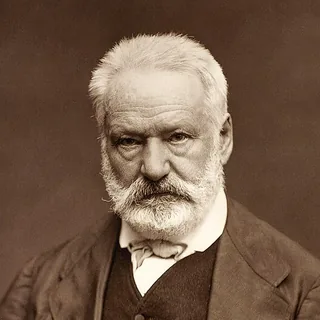
Victor Hugo
Key Facts
- Born on 26 February 1802 in Besançon, the son of an officer of Napoleon
- Sparked the battle of Hernani on 25 February 1830
- Published Notre-Dame de Paris in 1831 and was elected to the Académie française in 1841
- Went into exile after the coup of 2 December 1851, in Jersey and then Guernsey
- Published Les Misérables in 1862
- Returned to France in 1870 and became a senator in 1876
- Died in Paris on 22 May 1885; his state funeral took him to the Panthéon
Biography
Victor Hugo (1802-1885) was one of the greatest writers in the French language. A poet, playwright and novelist and the leading figure of Romanticism, he was also a committed politician who spent long years in exile for opposing Napoleon III. His state funeral in 1885 honoured a writer who had become a monument in his own lifetime.
Born on 26 February 1802 in Besançon, the son of Léopold Hugo, an officer of Napoleon who rose to the rank of general, he followed his father to Italy and Spain before settling in Paris with his mother. He published his first collections of poetry at a very young age and in 1822 married his childhood friend Adèle Foucher. The preface to his play Cromwell (1827) made him the theorist of Romantic drama, and the opening night of Hernani, on 25 February 1830, turned into a battle between Classicists and Romantics. Notre-Dame de Paris (1831), Ruy Blas (1838) and many collections of poems followed; he was elected to the Académie française in 1841.
On 4 September 1843 his daughter Léopoldine drowned in the Seine at Villequier together with her husband; this loss plunged him into a long literary silence. Made a peer of France in 1845, he was elected a deputy after the revolution of 1848 and gradually drew closer to the republicans. When Louis-Napoléon Bonaparte seized power in the coup of 2 December 1851, he tried to organise resistance, then had to flee to Brussels. Thus began an exile of almost nineteen years, in Jersey and then, from 1855, in Guernsey, where he settled at Hauteville House; he refused the amnesty of 1859. There he wrote the masterpieces of his maturity: Les Châtiments (1853), satirical poems against Napoleon III, Les Contemplations (1856) and Les Misérables (1862).
He did not return to Paris until September 1870, after the fall of the Second Empire, and lived through the Prussian siege of the capital. Elected a deputy in 1871 and then a senator in 1876, he called for an amnesty for the Communards while continuing to publish, notably The Art of Being a Grandfather (1877). He died in Paris on 22 May 1885, aged eighty-three. On 1 June, after he had lain in state beneath the Arc de Triomphe, an immense crowd followed his coffin to the Panthéon, restored for the occasion to its role as the resting place of the nation's great men.
A champion of liberty, a relentless opponent of the death penalty from The Last Day of a Condemned Man (1829) onwards, and an advocate of free and compulsory schooling and of a “United States of Europe”, Victor Hugo gave France some of its best-loved characters, from Quasimodo to Jean Valjean and Cosette. His works, translated all over the world and endlessly adapted for the stage, the cinema and the musical, make him one of the most widely read French writers in the world.