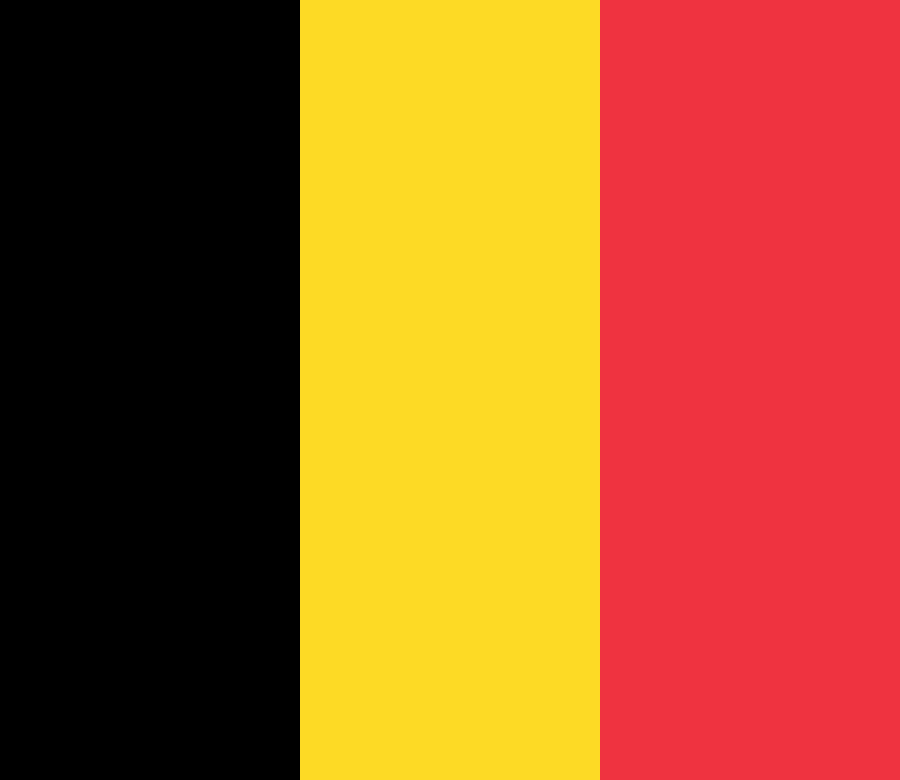
Adopted in 1831
| Capital | Brussels |
|---|---|
| Population | 11 876 844 inh. |
| Area | 30 689 km² |
| Population density | 387.0 inh./km² |
| Local time | --:-- |
| Language(s) | Dutch, French, German |
| Political system | Federal parliamentary constitutional monarchy |
| National motto | L'union fait la force - Eendracht maakt macht - Einigkeit macht stark (Unity makes Strength) |
| National anthem | La Brabançonne |
| Currency | Euro (EUR) |
| History | View timeline |
| Land borders | Netherlands, Germany, Luxembourg, France |
| Maritime borders | North Sea |
The flag: history and symbolism
Flag History
Black, yellow and red are the colours of the coat of arms of the former Duchy of Brabant: a golden lion on a black field, with red claws and tongue. They already appeared on the cockades of the Brabant Revolution of 1789-1790, which rose against Austrian rule.
During the Belgian Revolution of 1830, the insurgents in Brussels took up these colours again. The first flags, hastily sewn in August 1830, had horizontal stripes. By a decree of 23 January 1831, the Provisional Government introduced vertical stripes, in the manner of the French flag, partly to avoid any confusion with the horizontal flag of the Netherlands. The current order, with black at the hoist, only became established later.
The Constitution of 7 February 1831 enshrined these colours as those of the Belgian nation. The flag has not changed since: it came through both world wars and accompanied Belgium's transformation into a federal state, which began in 1970.
Meaning of Colours & Emblems
The Belgian flag has no official symbolism attached to each colour: above all, it reproduces the heraldry of Brabant, the historic heart of the country, where Brussels lies.
- Black: the field of the Brabant shield.
- Yellow: the golden lion that appears on it.
- Red: the lion's claws and tongue.
The choice of vertical stripes, in the manner of the French flag, reflects the influence of the liberal ideas of 1830, while marking the break with the Kingdom of the Netherlands, from which Belgium separated that year.
Anecdotes & Fun Facts
The official proportions of the Belgian flag are 13 by 15, which makes it almost square. In practice, most flags flown in Belgium follow the more elongated 2:3 format, including on many public buildings.
The decree of January 1831 placed red at the hoist, and the Constitution still lists the colours in the order ‘red, yellow and black’. Usage has nevertheless established the opposite order, which has led some historians to say that the Belgian flag flies ‘upside down’.
The Belgian flag is often confused with that of Germany, which uses very similar shades. The two flags are nonetheless easy to tell apart: vertical stripes and bright yellow for Belgium, horizontal stripes and gold in the order black, red, gold for Germany.
Similar Flags Around the World

Sport and history
Athletes
- Nafissatou Thiam
- Achiel Buysse
- Albéric Schotte
- Albert Sercu
- Alfons Schepers
- Alfred De Bruyne
- André Declerck
- André Dierickx
- André Rosseel
- Armand Desmet
- Arthur Decabooter
- Briek Schotte
- Carlo Bomans
- Claude Criquielion
- Cyrille Van Hauwaert
- Daniel Van Ryckeghem
- Daniel Willems
- Désiré Keteleer
- Dirk De Wolf
- Eddy Merckx
- Eddy Planckaert
- Edwig Van Hooydonck
- Eloi Meulenberg
- Emile Masson
- Eric Leman
- Eric Vanderaerden
- Ernest Sterckx
- Fons De Wolf
- Frank Hoste
- Frank Vandenbroucke
- Frans Bonduel
- Frans Verbeeck
- Freddy Maertens
- Gaston Rebry
- Georges Pintens
- Georges Ronsse
- Germain Derijcke
- Gilbert Desmet
- Greg Van Avermaet
- Guido Reybrouck
- Herman Frison
- Herman Van Springel
- Jasper Philipsen
- Jean-Luc Vandenbroucke
- Johan Capiot
- Johan De Muynck
- Johan Museeuw
- Joseph Bruyère
- Joseph Planckaert
- Jules Van Hevel
- Léon Scieur
- Leon Van Daele
- Louis Mottiat
- Ludo Peeters
- Marc Demeyer
- Marcel Kint
- Maurice Desimpelaere
- Maurice Dewaele
- Michel Pollentier
- Nick Nuyens
- Noël Foré
- Norbert Kerckhove
- Peter Van Petegem
- Philippe Gilbert
- Philippe Thys
- Pino Cerami
- Raymond Impanis
- Remco Evenepoel
- René Vermandel
- Rik Van Looy
- Rik Van Steenbergen
- Robert Van Eenaeme
- Roger De Vlaeminck
- Romain Gijssels
- Rudi Altig
- Sep Vanmarcke
- Stan Ockers
- Sylvère Maes
- Tim Wellens
- Tom Boonen
- Tom Steels
- Walter Godefroot
- Walter Planckaert
- Willy Bocklant
- Willy Van Neste
- Willy Vekemans
- Wout van Aert
- Marleen Renders
- Jacky Ickx
- Olivier Gendebien
Clubs
Competitions
Olympic Games
History
Frequently asked questions
What is the capital of Belgium?
Brussels is the capital of Belgium.
What do the colours of the flag of Belgium mean?
The Belgian flag has no official symbolism attached to each colour: above all, it reproduces the heraldry of Brabant, the historic heart of the country, where Brussels lies. Black: the field of the Brabant shield. Yellow: the golden lion that appears on it. Red: the lion's claws and tongue. The choice of vertical stripes, in the manner of the French flag, reflects the influence of the liberal ideas of 1830, while marking the break with the Kingdom of the Netherlands, from which Belgium separated that year.
Which countries border Belgium?
Belgium shares land borders with: Netherlands, Germany, Luxembourg, France.