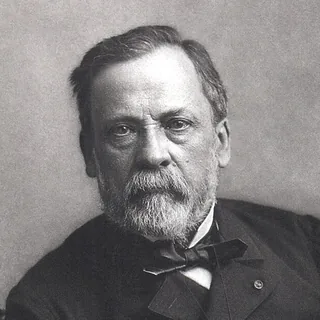
Louis Pasteur
Key Facts
- Born on 27 December 1822 in Dole, in the Jura, the son of a tanner
- Discovered molecular chirality in 1848 while studying tartaric acid
- Refuted spontaneous generation and patented pasteurisation in 1865
- Demonstrated the effectiveness of the anthrax vaccine at Pouilly-le-Fort in 1881
- Had young Joseph Meister vaccinated against rabies on 6 July 1885
- Founded the Pasteur Institute, inaugurated on 14 November 1888
- Died on 28 September 1895 at Villeneuve-l'Étang
Biography
Louis Pasteur (1822-1895) is one of the most famous scientists in history. A chemist by training, he demonstrated the role of micro-organisms in fermentation and disease, invented pasteurisation and developed vaccines made from weakened microbes, including the one against rabies.
Born on 27 December 1822 in Dole, in the Jura, the son of a tanner who had served as a soldier under Napoleon, he grew up in Arbois. Admitted to the École normale supérieure in 1843, he obtained his doctorate in 1847 and, as early as 1848, while studying crystals of tartaric acid, discovered that some molecules exist in two mirror-image forms, like a right and a left hand: this was the birth of molecular chirality. A professor in Strasbourg, he married Marie Laurent there in 1849; she would assist him in his work. Appointed dean of the new faculty of sciences in Lille in 1854, he took up the study of fermentation at the request of local manufacturers.
He proved that fermentation is the work of living organisms, then refuted the theory of spontaneous generation with famous experiments using swan-neck flasks, which earned him the Alhumbert Prize in 1862. He developed a heating process to protect wine from spoiling, patented in 1865: pasteurisation, later applied to beer and milk. At the request of Napoleon III, from 1865 to 1869 he studied the silkworm diseases that were ruining silk farming in the south of France. These were also years of hardship: three of his five children died young, and a stroke left him partly paralysed in 1868.
He then turned to infectious diseases. After chicken cholera, in 1881 at Pouilly-le-Fort he gave a public demonstration of his anthrax vaccine on farm animals. Elected to the Académie française the same year, he tackled rabies: on 6 July 1885 he had Joseph Meister, a nine-year-old boy from Alsace bitten by a rabid dog, vaccinated, and the boy survived. The success caused a sensation, and a public subscription opened in France and abroad made it possible to found the Pasteur Institute, inaugurated on 14 November 1888.
Pasteur died on 28 September 1895 at Villeneuve-l'Étang, near Paris, aged seventy-two. After a state funeral, he was laid to rest in a crypt at the Pasteur Institute, which carries on his work in France and through a network of institutes around the world. His research laid the foundations of microbiology and transformed hygiene, medicine and the food industry.