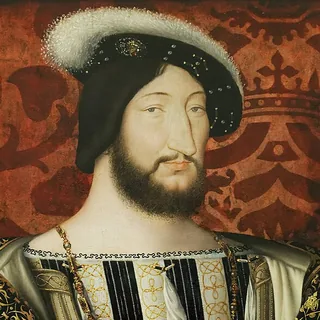
Francis I
Key Facts
- Born on 12 September 1494 at the Château de Cognac, son of Charles of Orléans and Louise of Savoy
- Became King of France on 1 January 1515 and won the Battle of Marignano that September
- Captured at Pavia on 24 February 1525 by the troops of Charles V
- Welcomed Leonardo da Vinci to France in 1516 and began building Chambord in 1519
- Founded the college of royal lecturers, the forerunner of the Collège de France, in 1530
- Made French the language of official documents through the Ordinance of Villers-Cotterêts (August 1539)
- Died on 31 March 1547 at the Château de Rambouillet
Biography
Francis I (1494-1547) reigned over France from 1515 to 1547. Victorious at Marignano in the very first year of his reign, then the unlucky rival of Charles V, he is remembered above all as the great prince of the French Renaissance, patron of artists and scholars, and builder of Chambord and Fontainebleau.
Born on 12 September 1494 at the Château de Cognac, he was the son of Charles of Orléans, Count of Angoulême, and Louise of Savoy, who kept a close watch on his education. A cousin of King Louis XII, who had no son, he became heir to the throne and on 18 May 1514 married the king's daughter, Claude of France. He succeeded Louis XII on 1 January 1515 and was crowned at Reims on 25 January. That September he crossed the Alps and defeated the Swiss mercenaries serving the Duke of Milan at Marignano, a victory that opened the Duchy of Milan to him; the following year the Concordat of Bologna, agreed with the Pope, gave him the right to appoint the bishops and abbots of the kingdom.
In 1519 he sought the imperial crown, but the prince-electors chose Charles V, King of Spain and ruler of the Low Countries, whose possessions encircled France. Neither the lavish meeting with Henry VIII of England at the Field of the Cloth of Gold in June 1520 nor the Italian campaigns loosened this grip: defeated and captured at Pavia on 24 February 1525, Francis was taken to Madrid. To regain his freedom he signed a treaty on 14 January 1526 that ceded Burgundy and handed over his two eldest sons as hostages, then repudiated it as soon as he returned. The Peace of Cambrai, known as the “Ladies' Peace”, suspended the conflict in 1529, and the king did not hesitate to ally himself with the Ottoman sultan Suleiman the Magnificent against the emperor.
His reign was also that of a kingdom asserting itself. In 1516 he welcomed Leonardo da Vinci, who died in 1519 at Clos Lucé, near Amboise; the same year work began on Chambord, while Fontainebleau would become the centre of an art inspired by Italy. In 1530 he founded the college of royal lecturers, the forerunner of the Collège de France, and in 1537 he required a copy of every book offered for sale to be deposited in his library. Through the Ordinance of Villers-Cotterêts, in August 1539, he made French the language of legal and administrative documents. He sent Jacques Cartier to explore the Gulf of St Lawrence in 1534, but in October of that year the Affair of the Placards, posters attacking the Mass put up in several towns, drove him to harsh repression of the Protestants.
He died on 31 March 1547 at the Château de Rambouillet, aged fifty-two, and was buried in the Basilica of Saint-Denis; his son Henry II succeeded him. His wars had drained the treasury without breaking the power of the Habsburgs, but his reign strengthened royal authority and left France Chambord, an official language and the image of a patron king, the man who was hailed as the “Father and Restorer of Letters”.