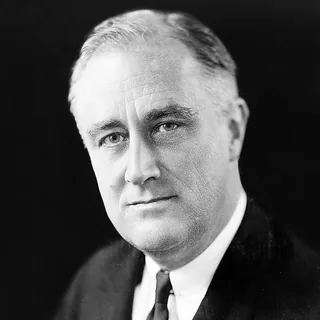
Franklin D. Roosevelt
Key Facts
- Born on 30 January 1882 in Hyde Park, New York
- Struck in August 1921 by a paralysis of the legs, attributed to polio
- Took office on 4 March 1933, at the depth of the Great Depression
- Launched the New Deal, including the Social Security Act of 1935
- The only American president elected four times: 1932, 1936, 1940 and 1944
- Led the United States into the Second World War after Pearl Harbor, on 7 December 1941
- Died on 12 April 1945 at Warm Springs, Georgia
Biography
Franklin Delano Roosevelt (1882-1945), the thirty-second President of the United States, is the only one ever elected to the White House four times. Taking office at the depth of the Great Depression, he used the New Deal to transform the role of the federal government, then led his country through the Second World War until victory was within sight.
Born on 30 January 1882 in Hyde Park, New York, into a wealthy family, he was a distant cousin of President Theodore Roosevelt, whose niece Eleanor he married on 17 March 1905. A Harvard graduate and a lawyer, he was elected to the New York State Senate as a Democrat in 1910 and served as Assistant Secretary of the Navy from 1913 to 1920 under Woodrow Wilson. After an unsuccessful run for the vice-presidency in 1920, he was struck in August 1921 by a paralysis of the legs, attributed to polio, from which he never recovered. He nevertheless returned to politics and became Governor of New York in 1929.
Elected president in November 1932 against Herbert Hoover, at a time when at least a quarter of the workforce was unemployed, he took office on 4 March 1933, declaring that “the only thing we have to fear is fear itself”. The “Hundred Days” that followed saw a series of emergency laws passed: rescuing the banks, public works, support for farmers. The New Deal continued with the Social Security Act of 1935, which introduced a system of old-age pensions and unemployment insurance. Through his radio “fireside chats” he spoke directly to Americans, who re-elected him by a wide margin in 1936 and again in 1940.
Faced with war in Europe, he supported the United Kingdom through the Lend-Lease Act of March 1941 and in August signed the Atlantic Charter with Winston Churchill. After the Japanese attack on Pearl Harbor on 7 December 1941, “a date which will live in infamy” in his words, the United States entered the conflict. In February 1942 his Executive Order 9066 allowed the internment of some 120,000 people of Japanese descent, most of them American citizens. He met Churchill and Stalin at Tehran in 1943 and, re-elected for a fourth term in 1944, at Yalta in February 1945. Exhausted, he died of a cerebral haemorrhage on 12 April 1945 at Warm Springs, Georgia, less than a month before the German surrender; Vice-President Harry Truman succeeded him.
His wife Eleanor, who was very active at his side, later became one of the architects of the Universal Declaration of Human Rights. The 22nd Amendment, ratified in 1951, has since limited presidents to two terms, in reaction to his four elections. Regarded by historians as one of the greatest American presidents, alongside Washington and Lincoln, he left behind a federal government far more involved in economic and social life, and he helped lay the foundations of the United Nations, founded a few months after his death.