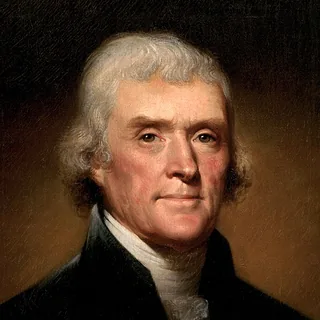
Thomas Jefferson
Key Facts
- Born on 13 April 1743 at Shadwell, Virginia
- Drafted most of the Declaration of Independence, adopted on 4 July 1776
- United States Minister to France from 1785 to 1789
- Third President of the United States, from 1801 to 1809
- Bought Louisiana from France in 1803, doubling the size of the country
- Founded the University of Virginia in 1819
- Died on 4 July 1826 at Monticello, on the same day as John Adams
Biography
Thomas Jefferson (1743-1826), the principal author of the Declaration of Independence and third President of the United States, from 1801 to 1809, is one of the most influential of the Founding Fathers. An Enlightenment thinker and a champion of religious freedom and natural rights, he was also a slaveholder all his life, a contradiction that weighs on his legacy.
Born on 13 April 1743 at Shadwell, Virginia, into a planter family, he studied at the College of William & Mary and became a lawyer. Elected to the Virginia House of Burgesses in 1769, he married Martha Wayles Skelton in 1772; she died in 1782. As a delegate to the Second Continental Congress, he drafted most of the Declaration of Independence, adopted on 4 July 1776, which proclaims that “all men are created equal” and endowed with unalienable rights, among them “Life, Liberty and the pursuit of Happiness”. He then served as Governor of Virginia from 1779 to 1781 and as Minister to France from 1785 to 1789, where he witnessed the beginning of the Revolution.
The country's first Secretary of State, under George Washington, from 1790 to 1793, he clashed with Alexander Hamilton and founded with James Madison the Democratic-Republican Party, which favoured states' rights and an agrarian republic. Vice-President under John Adams from 1797, he won the election of 1800, but a tie with Aaron Burr forced the House of Representatives to decide, on 17 February 1801, on the thirty-sixth ballot. As president, he bought Louisiana from Napoleon's France in 1803 for 15 million dollars, doubling the size of the country, and sent the Lewis and Clark expedition to explore the West as far as the Pacific (1804-1806). In 1807 he signed the act banning the importation of slaves from 1 January 1808.
His second term was overshadowed by the Embargo Act of 1807, which barred American ships from trading abroad in order to keep the country out of the Napoleonic Wars, and which dealt a heavy blow to the economy. Retiring to his Monticello estate, he founded the University of Virginia in 1819; it opened its doors in 1825. Over his lifetime he owned some 600 enslaved people and freed only a handful of them, during his life or by his will; most historians now accept that he was the father of the children of Sally Hemings, one of the women he held in slavery. Deep in debt, he died on 4 July 1826, the fiftieth anniversary of the Declaration, on the same day as John Adams.
For his grave he wrote his own epitaph, which records just three titles: author of the Declaration of Independence and of the Virginia Statute for Religious Freedom, and father of the University of Virginia, without a word about his presidency. His face appears on Mount Rushmore and on the two-dollar bill, and his words on human equality were invoked by abolitionists and by the civil rights movement alike. Yet the contrast between his principles and his life as a slaveholder makes him one of the most debated figures in American history.