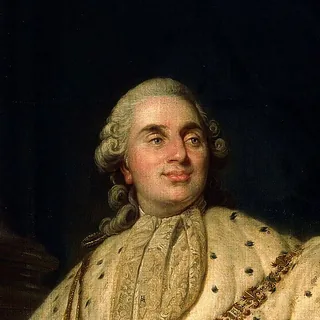
Louis XVI
Key Facts
- Born on 23 August 1754 at the Palace of Versailles, grandson of Louis XV
- Married Marie Antoinette of Austria in 1770 and became king on 10 May 1774
- Supported the independence of the United States through the 1778 alliance
- Summoned the Estates-General, which opened at Versailles on 5 May 1789
- Arrested at Varennes during his flight in June 1791
- Overthrown on 10 August 1792, he was guillotined in Paris on 21 January 1793
Biography
Louis XVI (1754-1793) was the last King of France of the Ancien Régime. He came to the throne in 1774 and saw absolute monarchy swept away by the French Revolution: overthrown on 10 August 1792, he was tried by the National Convention and guillotined on 21 January 1793, aged thirty-eight.
Born on 23 August 1754 at the Palace of Versailles, Louis-Auguste, Duke of Berry, was the grandson of Louis XV. His father's death, on 20 December 1765, made him Dauphin. In 1770 he married Archduchess Marie Antoinette, daughter of Empress Maria Theresa of Austria, a union that sealed the rapprochement between France and the Habsburgs. He succeeded his grandfather on 10 May 1774, aged nineteen, and was crowned at Reims on 11 June 1775. Shy and devout, with a passion for geography and lockmaking, on his accession he recalled the parlements that Louis XV had sidelined.
The early years of the reign were marked by attempts at reform. The Controller-General Turgot sought to free the grain trade and abolish the royal corvée, but he was dismissed in 1776 in the face of opposition from the privileged orders, and Necker was then put in charge of the finances. In 1780 Louis XVI abolished the question préparatoire, the torture inflicted on suspects to extract confessions, and the Edict of Tolerance of November 1787 gave Protestants back a civil status. Above all, he supported American independence: the alliance concluded with the rebels in 1778 led to the victory at Yorktown and the Treaty of Paris of 1783, but the war added further to the kingdom's debt.
To overcome the financial crisis, the king gathered an Assembly of Notables in 1787 and then summoned the Estates-General, which opened at Versailles on 5 May 1789. The deputies of the Third Estate proclaimed themselves the National Assembly on 17 June, and the storming of the Bastille on 14 July forced Louis XVI to give way. Brought back by force from Versailles to Paris during the October Days of 1789, he took up residence in the Tuileries. His flight, on the night of 20 to 21 June 1791, ended with his arrest at Varennes and destroyed the people's trust. He accepted the Constitution in September 1791 and became King of the French, but his vetoes of decrees passed by the Assembly and the war declared on Austria in April 1792 deepened suspicions of treason.
On 10 August 1792 a Parisian insurrection stormed the Tuileries; the royal family was imprisoned in the Temple, and the Convention abolished the monarchy on 21 September. Found guilty of conspiracy against public liberty, “Louis Capet” was sentenced to death and guillotined on 21 January 1793 in the Place de la Révolution, today's Place de la Concorde. Marie Antoinette followed him to the scaffold on 16 October 1793, and their son, Louis XVII to the royalists, died in the Temple in 1795. His remains were transferred to the Basilica of Saint-Denis on 21 January 1815, under the Restoration. A well-meaning but irresolute king, Louis XVI embodies the fall of absolute monarchy.