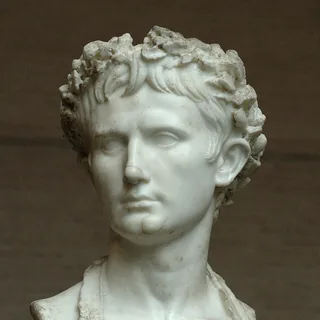
Augustus
Key Facts
- Born Gaius Octavius on 23 September 63 BC in Rome, the great-nephew of Julius Caesar
- Adopted in the will of Caesar, who was assassinated in March 44 BC
- Formed the Second Triumvirate with Mark Antony and Lepidus in 43 BC
- Defeated Antony and Cleopatra at Actium on 2 September 31 BC
- Received the title of Augustus from the Senate on 16 January 27 BC: the start of the Principate
- Lost three legions in the Teutoburg Forest in AD 9
- Died at Nola on 19 August AD 14; Tiberius succeeded him
Biography
Augustus, born Gaius Octavius in 63 BC, was the first Roman emperor and reigned until his death in AD 14. The great-nephew and adopted son of Julius Caesar, he brought almost a century of civil wars to an end and turned the Republic into a monarchy that kept up the appearance of the old institutions: the Principate. His reign of more than forty years opened a long period of stability, the Pax Romana.
Born on 23 September 63 BC in Rome, he was the son of a senator and of Atia, Julius Caesar's niece. Octavian, as historians call him, was only eighteen when Caesar was assassinated on the Ides of March 44 BC; the dictator's will made him his adopted son and principal heir, and he took the name Caesar. At first a rival of Mark Antony, he allied himself with him and with Lepidus in 43 BC in the Second Triumvirate, which proscribed its opponents, Cicero among them. In 42 BC the triumvirs crushed Caesar's assassins, Brutus and Cassius, at Philippi in Macedonia.
The division of the Roman world between Octavian, master of the West, and Antony, settled in the East with Cleopatra, led to a new war. On 2 September 31 BC the fleet of Agrippa, his loyal general, won the day at Actium; the following year Antony and Cleopatra took their own lives and Egypt came under his control. On 16 January 27 BC the Senate granted him the title of Augustus. Without ever proclaiming himself king, he accumulated powers: command of the armies, tribunician power and, from 12 BC, the office of pontifex maximus. He created a standing army stationed on the frontiers and the Praetorian Guard, reorganised the administration of the provinces and embellished Rome so lavishly that, according to Suetonius, he boasted of having found it a city of brick and left it a city of marble.
The end of his reign was darkened by family tragedies and military setbacks. Having no son, Augustus saw the heirs he had chosen die one after another, among them his grandsons Gaius and Lucius Caesar, and in AD 4 he resigned himself to adopting Tiberius, the son of his wife Livia. In AD 9 three legions under Varus were wiped out by the Germanic chieftain Arminius in the Teutoburg Forest, which halted the conquest of Germania. Augustus died on 19 August AD 14 at Nola, in Campania, aged seventy-five, and Tiberius succeeded him.
Deified by the Senate after his death, Augustus left an account of his deeds, the Res Gestae, engraved on bronze tablets in front of his mausoleum. The month of August bears his name, just as July honours Caesar. The regime he founded lasted, in various forms, for centuries, and his name itself became a title borne by all his successors.