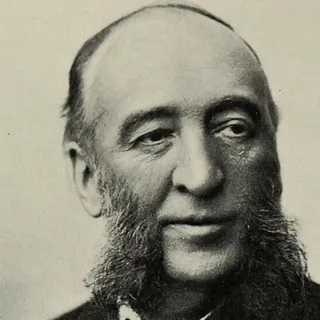
Key Facts
- 5 April 1832: born in Saint-Dié (Vosges)
- 1870-1871: Mayor of Paris during the siege
- 1879: Minister of Public Instruction
- 16 June 1881: law making state primary schools free
- 28 March 1882: law on compulsory schooling and secular state education
- 1881: French protectorate over Tunisia
- 17 March 1893: dies in Paris, three weeks after his election as President of the Senate
Biography
Jules Ferry (1832-1893), a lawyer and republican statesman who was twice Prime Minister under the Third Republic, was the founder of free, compulsory and secular state schooling in France. He was also one of the main architects of French colonial expansion, an aspect of his work that is heavily criticised today.
Born in Saint-Dié, in the Vosges, on 5 April 1832, he became a lawyer in Paris and opposed the Second Empire as a journalist. In 1868 he denounced Baron Haussmann's management of Paris in a celebrated pamphlet, Les Comptes fantastiques d'Haussmann. Elected republican deputy for Paris in 1869, he joined the Government of National Defence after the fall of Napoleon III and became Mayor of Paris during the siege of the capital, from November 1870 to June 1871. Food shortages made him deeply unpopular, and he left office after the Commune.
As Minister of Public Instruction from 1879, he secured the passage of the laws that bear his name: the law of 16 June 1881 made state primary schools free, and that of 28 March 1882 made schooling compulsory for children aged six to thirteen and state education secular. Religious instruction was replaced by moral and civic instruction. On his initiative, secondary schools for girls were created in 1880, as were teacher training colleges for women in every department. His governments also passed the great laws of 1881 on freedom of the press and of public assembly.
Prime Minister from 1880 to 1881 and again from 1883 to 1885, he pursued an active colonial policy: a protectorate over Tunisia in 1881, the conquest of Annam and Tonkin, and the preparation of the occupation of Madagascar. In a notorious speech to the Chamber, he claimed that the “superior races” had a duty to civilise the “inferior races”. His opponents, from Georges Clemenceau to the nationalist right, also accused him of diverting France from revenge against Germany. Exaggerated reports of a military setback at Lang Son, in Tonkin, brought him down in March 1885; he was then nicknamed “Ferry-Tonkin”.
An opponent of General Boulanger, he stood unsuccessfully for the presidency of the Republic in December 1887 and was shot and wounded a few days later in an assassination attempt. Elected President of the Senate in February 1893, he died of a heart attack in Paris on 17 March 1893, aged sixty, and was buried in Saint-Dié. A great many schools bear his name today, but his legacy is also criticised: besides his colonial policy, he is blamed for imposing French alone in schools, at the expense of regional languages.
Sources: Wikipédia, « Jules Ferry »; Wikipedia, « Jules Ferry »
French heads of government (1880-1881)
French heads of government (1883-1885)
Also worth discovering
Last updated: