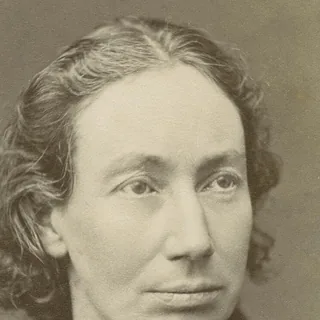
Key Facts
- 29 May 1830: born at Vroncourt, Haute-Marne
- 1856: settles in Paris as a schoolteacher
- 18 March 1871: in Montmartre when the Commune breaks out
- December 1871: sentenced to deportation
- 1873-1880: deported to New Caledonia
- 1883: sentenced to six years in prison, pardoned in 1886
- 9 January 1905: dies in Marseille
Biography
Louise Michel (1830-1905), a schoolteacher and revolutionary activist, was one of the great figures of the Paris Commune. A fighter on the barricades in 1871 and deported to New Caledonia, she became on her return an anarchist orator famous throughout Europe. Nicknamed the “Red Virgin”, she embodied courage and loyalty to one's ideas for the labour movement.
Born on 29 May 1830 at the château of Vroncourt in Haute-Marne, she was the daughter of a servant and probably of the son of the owners of the château, who brought her up and gave her a sound education. Having become a teacher, she refused to swear allegiance to Emperor Napoleon III and opened an independent school. Settling in Paris in 1856, she taught, wrote poems, corresponded with Victor Hugo and frequented republican and socialist circles. At the end of the Empire she ran a school in Montmartre.
During the Prussian siege of Paris in 1870 she led the Montmartre women's vigilance committee. On 18 March 1871 she was on the hill when the crowd prevented the army from seizing the cannons of the National Guard, the event that triggered the Commune. During the two months of the insurrection she was at once an ambulance worker, a propagandist and a fighter, rifle in hand, in the ranks of the National Guard. During the Bloody Week she fought on the barricades, then gave herself up to the Versailles troops to secure the release of her mother, arrested in her place.
Tried in December 1871, she proudly claimed responsibility for her actions before the court martial and demanded death. Sentenced to deportation, she arrived in New Caledonia in 1873 after a four-month voyage. During her exile she became an anarchist, taught the deportees' children and took an interest in the culture of the Kanaks, whose revolt in 1878 she understood, unlike most of the other Communards. The amnesty of 1880 allowed her to return to Paris, where a huge crowd welcomed her.
She then devoted herself to anarchist propaganda, adopted the black flag and gave many lectures in France and abroad. Sentenced in 1883 to six years in prison after a demonstration of unemployed workers during which bakeries were looted, she was pardoned in 1886. In 1888 in Le Havre a man shot her in the head; she refused to press charges against him. She then lived for several years in London. She died in Marseille on 9 January 1905 during a lecture tour, and tens of thousands of people followed her funeral in Paris.
Sources: Wikipédia, « Louise Michel »; Wikipedia, « Louise Michel »
Related event
Also worth discovering
Portrait (cropped): J.M. Lopez, CC BY-SA 3.0, Wikimedia Commons

Last updated: