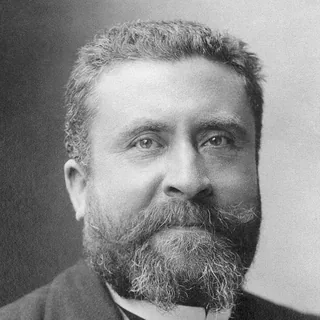
Key Facts
- 3 September 1859: born in Castres (Tarn)
- 1885: elected deputy for the Tarn
- 1892: Carmaux miners' strike, conversion to socialism
- 18 April 1904: founds L'Humanité
- 1905: unification of the socialists in the SFIO
- 31 July 1914: assassinated at the Café du Croissant in Paris
- 1924: his ashes are transferred to the Panthéon
Biography
Jean Jaurès (1859-1914), a philosopher, historian and politician, is the great figure of French socialism. Founder of the newspaper L'Humanité, the chief architect of socialist unity and a defender of Captain Dreyfus, he waged a stubborn fight for peace until his death. His assassination on 31 July 1914, on the eve of the First World War, made him a symbol.
Born in Castres, in the Tarn, on 3 September 1859, into a lower-middle-class family, he entered the École normale supérieure in 1878, passed the agrégation in philosophy and then taught at the lycée in Albi and at the University of Toulouse. In 1885 he was elected deputy for the Tarn as a moderate republican close to Jules Ferry. Defeated in 1889, he returned to teaching, defended his doctoral thesis and took part in the municipal life of Toulouse.
The great Carmaux miners' strike of 1892, triggered by the dismissal of a trade unionist miner who had become the town's mayor, completed his conversion to socialism. Elected deputy for Carmaux in 1893, he became one of the most listened-to speakers in the Chamber. At first convinced of Dreyfus's guilt, he then resolutely took up his defence and published Les Preuves in 1898; this commitment cost him his seat the same year. Re-elected in 1902, he supported the Bloc des gauches and helped draft the 1905 law on the separation of the Churches and the State. He also directed a Socialist History of the French Revolution.
On 18 April 1904 he founded the daily L'Humanité. The following year, with Jules Guesde, he brought about the unification of the socialist currents within the French Section of the Workers' International (SFIO). In L'Armée nouvelle (1910) he proposed a national defence based on a citizens' army. As tensions rose in Europe, he fought the law extending military service to three years, passed in 1913, and called on socialists of all countries to unite to prevent war.
On 31 July 1914, as Europe was tipping into war, he was shot dead at the Café du Croissant in Paris by Raoul Villain, a young nationalist. Three days later, Germany declared war on France. Acquitted in 1919, his assassin was set free, to the outrage of the left. Jaurès's ashes were transferred to the Panthéon in 1924. A great many streets, squares and schools bear his name today, and his memory is claimed far beyond the socialist camp alone.
Sources: Wikipédia, « Jean Jaurès »; Wikipedia, « Jean Jaurès »
Related event
Also worth discovering
Last updated: