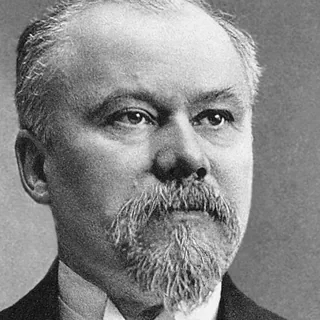
Key Facts
- 20 August 1860: born in Bar-le-Duc (Meuse)
- 1887: elected deputy for the Meuse
- 1909: elected to the Académie française
- 17 January 1913: elected President of the Republic
- January 1923: occupation of the Ruhr
- 1928: stabilisation of the franc
- 15 October 1934: dies in Paris
Biography
Raymond Poincaré (1860-1934), a lawyer and statesman from Lorraine, was one of the dominant figures of the Third Republic. President of the Republic throughout the First World War, he also headed the government on three occasions. A figure of the moderate republican right, he embodied firmness towards Germany and financial rigour.
Born in Bar-le-Duc, in the Meuse, on 20 August 1860, a cousin of the mathematician Henri Poincaré, he became a lawyer in Paris and was elected deputy for the Meuse as early as 1887. Minister of Public Instruction in 1893 and then of Finance in 1894, he entered the Senate in 1903 and the Académie française in 1909. A moderate republican, he was one of the founders of the Democratic Republican Alliance, which became the main centre-right party.
Prime Minister and Foreign Minister from January 1912, he strengthened the alliance with Russia. On 17 January 1913 he was elected President of the Republic. When war broke out in August 1914, he called for the “Sacred Union” of all French people. Despite their mutual hostility, he appointed Georges Clemenceau Prime Minister in November 1917; victory came a year later. Historians still debate his share of responsibility for the chain of events of the summer of 1914. His left-wing opponents dubbed him “Poincaré-la-guerre” (Poincaré the warmonger).
When his term ended in 1920, he returned to the Senate. Prime Minister again from January 1922, he demanded that Germany pay the reparations laid down by the Treaty of Versailles and had the Ruhr occupied in January 1923, a highly controversial decision, especially in the English-speaking world; French troops did not leave until 1925. Defeated by the Cartel des gauches in the 1924 elections, he returned to power in July 1926, in the midst of a serious financial crisis, at the head of a government of national union.
As Finance Minister as well as Prime Minister, he restored confidence and stabilised the currency: the “Poincaré franc”, worth only a fifth of the pre-war franc, was fixed in 1928. In poor health, he left office in July 1929. He died in Paris on 15 October 1934, aged seventy-four, and was buried in Nubécourt, in the Meuse. His memoirs, published under the title Au service de la France, recount his years in power. He is remembered as an upright and hard-working statesman, but also as an austere leader, more respected than loved.
Sources: Wikipédia, « Raymond Poincaré »; Wikipedia, « Raymond Poincaré »
French heads of government (1912-1913)
French Presidents (1913-1920)
French heads of government (1922-1924)
French heads of government (1926-1929)
Also worth discovering
Last updated: