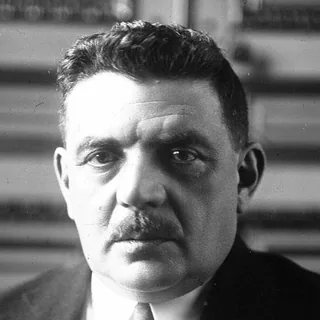
Key Facts
- 5 July 1872: born in Troyes
- 1905: elected mayor of Lyon
- 1924: Prime Minister at the head of the Cartel des gauches
- 1925: brought down by the Senate, denounces the wall of money
- 10 July 1940: abstains in the vote of full powers to Pétain
- 1947-1954: President of the National Assembly
- 26 March 1957: dies at Saint-Genis-Laval
Biography
Édouard Herriot (1872-1957), a literature teacher who became a leading figure of the Radical Party, was mayor of Lyon for half a century and three times Prime Minister under the Third Republic. Leader of the Cartel des gauches in 1924 and several times President of the Chamber of Deputies and then of the National Assembly, he embodies the parliamentary Republic of the interwar years.
Born in Troyes on 5 July 1872, the son of an army officer, he entered the École normale supérieure in 1891 and came first in the agrégation in literature in 1894. Appointed to teach at the lycée in Nantes and then in Lyon, he defended in 1904 an acclaimed thesis on Madame Récamier and her circle. Active in the Dreyfusard and radical cause, he was elected mayor of Lyon in 1905: he would remain so until his death, except during the war years from 1940 to 1945, and transformed the city through major public works.
Minister of Public Works, Transport and Supplies in 1916 and 1917, he became leader of the Radical Party in 1919. After winning the elections of May 1924 at the head of the Cartel des gauches, he became Prime Minister: he recognised the Soviet Union, agreed to withdraw from the Ruhr and had Jaurès's ashes moved to the Panthéon. The Senate brought him down in April 1925; Herriot then blamed the “wall of money”, meaning the financial powers, for wrecking his policy. He held office for only a few days in July 1926, then served as Poincaré's Minister of Public Instruction until 1928.
Prime Minister again in 1932, he resigned in December that year after the Chamber refused to pay the instalment of the war debt owed to the United States. During a visit to the USSR in 1933 he denied the existence of the famine then ravaging Ukraine, taken in by Soviet propaganda. President of the Chamber of Deputies from 1936 to 1940, he abstained in the vote granting full powers to Philippe Pétain on 10 July 1940. Placed under house arrest, he was handed over to the Germans in 1944 and ended the war in deportation near Berlin, where the Red Army freed him.
Back in Lyon, he was elected to the Académie française in 1946 and presided over the National Assembly of the Fourth Republic from 1947 to 1954. An uncompromising defender of national sovereignty, in August 1954, from a wheelchair, he gave one of his last speeches against the European Defence Community. He died on 26 March 1957 at Saint-Genis-Laval, near Lyon, aged eighty-four. The Édouard Herriot hospital, the port Édouard-Herriot and many other places in Lyon bear his name.
Sources: Wikipédia, « Édouard Herriot »; Wikipedia, « Édouard Herriot »
French heads of government (1924-1925)
French heads of government (1926)
French heads of government (1932)
Also worth discovering
Last updated: