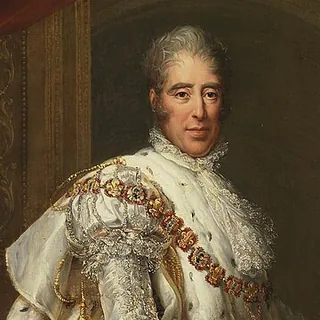
Key Facts
- Bears the title of Count of Artois as the youngest brother of Louis XVI
- Emigrates as early as 1789 and lives in exile until the Restoration
- Becomes king on 16 September 1824, on the death of Louis XVIII
- Is crowned at Reims in May 1825, the last coronation in French history
- Signs the July Ordinances of 1830, which spark the Three Glorious Days
- Abdicates on 2 August 1830
- Dies of cholera in Gorizia on 6 November 1836
Biography
Charles X (1757-1836), King of France and Navarre from 1824 to 1830, was the last monarch of the senior branch of the Bourbons. The younger brother of Louis XVI and Louis XVIII and the leader of the ultra-royalists, he had himself crowned at Reims according to the ritual of the Ancien Régime, but his authoritarian policies provoked the July Revolution, which drove him from the throne in 1830.
Born at the Palace of Versailles in 1757, Charles Philippe of France was the youngest son of the Dauphin Louis and bore the title of Count of Artois. Hostile to reform, he left France as early as 1789 and spent the whole revolutionary and Napoleonic period in exile, mainly in Great Britain. Back in France with the Restoration, he became, under his brother Louis XVIII, the leader of the ultras, who favoured a strong monarchy and opposed constitutional government and the legacy of the Revolution.
He became king on 16 September 1824, at almost sixty-seven, making him the oldest heir ever to ascend the French throne. In May 1825 he was crowned at Reims, the last coronation in French history, during which he revived the royal touch, believed to heal sufferers of scrofula. His government passed a law compensating the émigrés whose property had been confiscated during the Revolution, known as the “émigrés' billion”, as well as a law making certain acts of sacrilege punishable by death.
His successive ministries, led by Villèle, Martignac and then, from 1829, Polignac, clashed with an increasingly liberal Chamber of Deputies. Abroad, France intervened in Greece with the Morea expedition in 1828 and seized Algiers in 1830, opening the conquest of Algeria. After the opposition won the elections, Charles X signed the July Ordinances of 1830 at Saint-Cloud, which dissolved the Chamber, restricted the franchise and reimposed press censorship. Paris rose at once: these were the Three Glorious Days, from 27 to 29 July.
On 2 August 1830 the king abdicated in favour of his grandson, the Duke of Bordeaux, but the crown went to his cousin Louis Philippe of Orléans, proclaimed “King of the French”. Charles X went back into exile, first at Holyrood Palace in Scotland, then in Prague and Gorizia, where he died of cholera on 6 November 1836, aged seventy-nine, six years after his fall. He was buried at the Kostanjevica Monastery, now in Slovenia.
Sources: Wikipédia, « Charles X »; Wikipedia, « Charles X of France »
Kings of France (1824-1830)
Also worth discovering
Last updated: